
The figure has just ballooned: from 400 to 436 billion euros for the “Defense” budget. If you run an SME in the sector, you may have seen this increase as good news that automatically benefits you. That is precisely where the trap snaps shut. This update does not distribute a larger sum; it simply digs a deeper channel in a path that has already been laid out. Worse still: this surplus has already nearly vanished along the way. The real question, then, is not “how much more for me?” but “am I even in the room where these decisions are being made?”
436 billion euros.
That figure reassures you. It shouldn't.
Not because it is incorrect. It is official: following the update to the military programming law, the budgetary resources for the “Defense” mission—excluding pension costs—will include €36 billion in additional funding spread over 2026–2030, bringing the total to €436 billion in current prices for the 2024–2030 period. The government is presenting this as an effort intended to double defense spending in 2027 compared to 2017.
But a growing budget doesn’t mean more money for everyone. It means the pace is picking up. And what determines whether your SME is in the flow of that money—or on the sidelines watching it pass by—has almost nothing to do with your technical excellence. With ten days to go before Eurosatory, where hundreds of SMEs will come to claim their share, here is the mirror that few dare to hold up to you.
Let's read the text, not the press release.
First, the surplus is earmarked. This additional €36 billion will be invested primarily in key sectors: ammunition, drones, and space. The president outlined three main priorities: bolstering ammunition stocks, ensuring sovereignty through satellite- and radar-based early warning systems, and improving the protection of military personnel, the effectiveness of strikes, and the expansion of the drone fleet.
So much for the masses. Now, the real message.
The update does not spread resources more thinly; rather, it further concentrates them. The balance of power confirms this: for drones, the bill already allocates 8.4 billion euros, driven by lessons from Ukraine, which, according to one senator, has gone from producing zero drones in 2023 to producing and deploying 9 million units in 2026.
When an industry booms like this, the money goes to those who are already identified, qualified, and mapped out—not to those who show up at the counter once the call for bids has been published.
Because the natural beneficiaries already exist. “When we entered the defense sector, we started by mapping out the key players: the DGA, Bercy, GICAT, and GICAN. We also attended all the trade shows: Le Bourget, Eurosatory, and Euronaval,” says an executive in a Bpifrance study. Those already on the DGA, AID, and EMA’s radar pick up on early-stage decisions. The others review the requests for proposals once they’re published.
The bottom line: The update doesn't create new entries; it simply highlights those that are already visible.
Here’s the data that should dampen any automatic enthusiasm. And it’s spectacular.
On April 8, 2026, the National Assembly approved the budget update, increasing the allocation to 436 billion euros. Press releases, satisfaction, rearmament. Then, in late May 2026, a dramatic turn of events in the Senate: overnight from Tuesday to Wednesday, a majority of senators voted against Article 2—the core of the bill—which dealt with the additional €36 billion in funding. The net result: the budget trajectory remains unchanged, and the additional funding is reduced to zero.
Read this carefully. In six weeks, 36 billion euros went from “approved” to “canceled” following a late-night vote. Against this backdrop, the only real question—asked by a senator—was: Who is paying for these billions? We need to tell the truth.
This episode is not just a parliamentary anecdote. It is your reality as a business leader, in fast-forward. Because the same phenomenon is already playing out on your level. As early as June 2025, the Senate warned: “We’re seeing companies in trouble because orders aren’t coming in.” It pointed to a “double wall: that of debt and that of a lack of orders,” as BITD companies have drawn on their cash reserves while waiting for orders that are slow in coming.
The message is crystal clear: even if a budget increase is approved, it doesn’t guarantee that a contract will materialize. Above all, it guarantees that the funds actually released will go first to the players who have already been identified. A rising tide doesn’t lift all boats. It fills the channel first, and when the water recedes, it’s the banks that dry up first.
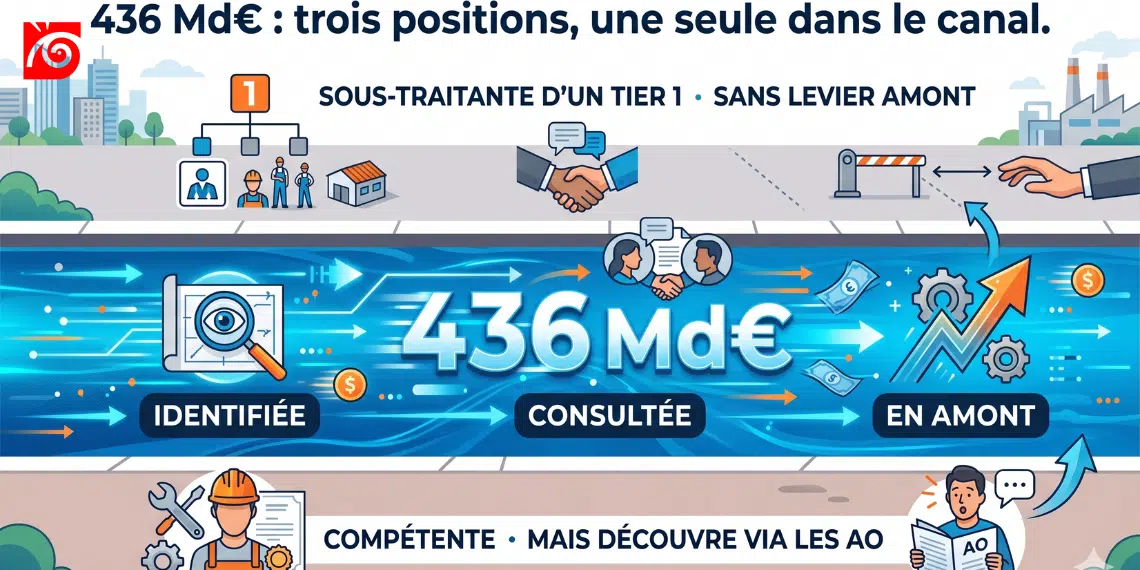
There are three ways to be “on the defensive” when 436 billion is at stake. Only one is comfortable.
Your small or medium-sized business is identified, approached, and consulted early in the planning stages of programs. When the DGA issues an industrial policy guidance document to provide companies with more targeted insights on specific topics, you’re already in the discussion. Your brand, your messaging, and your institutional presence have put you in this position. Opportunities come to you.
You have the skills. Sometimes the best ones. But no one thinks of you when decisions are being made. You find out about opportunities through published calls for bids—too late, when the requirements have already been defined by others. The cruelest part: you deserve first place, and nothing in your expertise justifies second place.
You think you’re in the defense sector because you sell to a Tier 1 supplier. In reality, you’re a subcontractor to a subcontractor, with no visibility or influence over upstream decisions. It’s a precarious position: the defense industry is driven and sustained by small and medium-sized enterprises, but strategy is set by the procurement executives of large corporations. You’re under pressure from tight deadlines, a lack of visibility, and late payments.
➡️Honestly, without flattering your ego: are you in 1st, 2nd, or 3rd place?
Most people instinctively answer “1.” The reality of the market is harsher. To recap: the BITD comprises nine major groups, 4,500 SMEs and startups, 1,000 of which are identified as strategic. One thousand “strategic” companies out of 4,500. The selection process has already begun, and it is not based solely on technical merit.
The good news is that your position isn’t set in stone. The bad news is that it can’t be resolved by the sales team. Three factors determine it, and none of them are within the sales team’s control.
| Lever | The killer question | Why it matters |
|---|---|---|
| Strategic clarity | Can a busy buyer understand your positioning in 30 seconds? | The DGA continues to streamline its specifications: it favors those that can be quickly and accurately identified. |
| Institutional presence | Are you part of the right circles (GICAT, GIFAS, regional clusters, DGA events) and able to make your voice heard? | This is where stakeholders are identified and defense accelerators for strategic SMEs are launched. |
| Trust Capital | Do your marketing materials (website, brochure, presentations) make you look like a well-established company or an SME that “also does defense work”? | In a market where the government maintains a list of certified suppliers, appearing well-organized is a key selection criterion, not just a minor detail. |
Look at these three levers. None of them are sales-related. They pertain to branding and governance.
That is precisely why business leaders underestimate them. We readily invest in machinery, patents, and engineers. But we are reluctant to invest in our brand’s visibility, presence, and reputation. Yet these are the very factors that determine your position in the market. Consider this counterexample: an SME that, because it wasn’t recognized in France, couldn’t win French contracts and generated 75% of its revenue from exports before gaining traction in France. The product was good. Visibility was lacking.
Let's start over from the beginning.
The update will allocate an additional 36 billion euros, bringing the total to 436 billion. That is, if Parliament approves it. The question isn’t how much you’ll receive. It’s whether you’re in the room where these decisions are made, or in the hallway, waiting for the doors to open and hoping they don’t close again, as they did one night in May in the Senate.
The feed will not perform the sorting. It will simply confirm the sorting that has already been done.
And you can still turn this situation to your advantage. But not with a better sales pitch. Rather, through a redefined strategic vision, a confident institutional presence, and a foundation of trust that elevates you from the status of a “subcontractor that also does defense work” to that of a well-established, recognized, and sought-after player. This is a matter of brand-building and governance. It is, precisely, the realm of Governance Foundation.
If you’re unsure about your position, that’s exactly what ourPositioning Assessment is designed to determine. Through a few brief discussions, we’ll objectively assess whether your small business is in position 1, 2, or 3—and what’s keeping you from driving traffic.




