
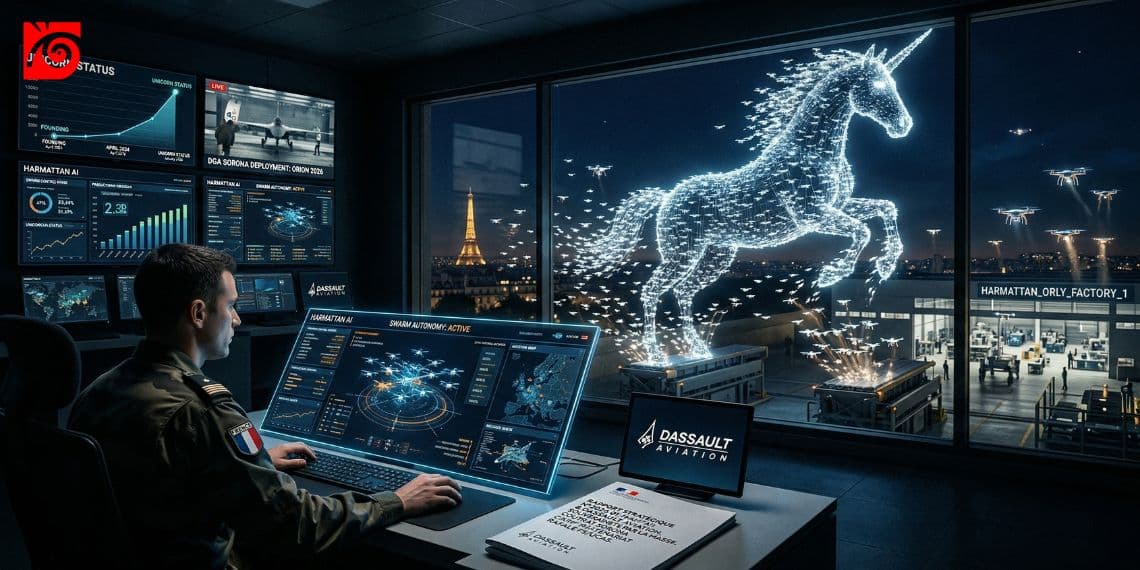
The Reversal of the Value Chain: Harmattan has demonstrated that in modern warfare, value shifts from the hardware platform (the drone) to the software brain (AI). Hardware becomes “expendable,” while software remains paramount.
Dominance Through Semantics: The startup didn’t sell products; it imposed new strategic concepts (“attritability,” “military mass market”) that reshaped the way the DGA and Dassault thought.
The “Hybrid Founder” as an Intangible Asset: Mouad M’Ghari’s profile (technocrat-warrior-engineer) is the cornerstone of the brand’s credibility. He speaks both the language of risk (Tech) and that of mission (Sovereignty).
The Dassault Alliance: Validation, Not Takeover: The $200 million investment is not financial aid, but an endorsement of the company’s capabilities. Dassault is acquiring the speed and software agility it lacks in-house to secure the Rafale F5.
Speed as a Mark of Authority : Becoming a unicorn in just 20 months in an industry characterized by 10-year cycles isn’t an operational achievement—it’s a demonstration of narrative power that outshines the slow-moving traditional competition.
On January 15, 2026, Harmattan AI’s $1.4 billion valuation sent shockwaves through the industry. To casual observers, it was the crowning achievement of a promising tech startup. For strategists, it was the validation of a masterful narrative heist. How could a company less than two years old have broken French industrial dogma, established itself as the indispensable partner for the future European fighter jet, and redefined the very concept of sovereignty? This analysis deciphers how visionary governance transformed a technical constraint into global strategic dominance. If Dassault invested 200 million, it wasn’t for drones: it was for the governance software that Harmattan embodies.
To understandHarmattan’s rise, one must first acknowledge the strategic obsolescence of the traditional Defense Industrial and Technological Base (BITD) in the face of recent high-intensity conflicts, particularly in Ukraine.
For 40 years, Western military doctrine has relied on high-performance, ultra-expensive weapons systems produced in small quantities, with an absolute aversion to material losses (a $100 million Rafale fighter jet must not be lost). This logic, which holds up against asymmetric threats, collapses in the face of an adversary capable of saturating the battlefield with low-cost drones. Modern warfare has once again become a statistical war of attrition.
Defense giants are hardware assemblers (engineering “screw-turners”). They design an aircraft to last 30 years, with software update cycles of 5 to 10 years. Harmattan AI was born from the opposite observation: operational superiority comes from embedded AI software, capable of updating itself weekly to adapt to the constraints of enemy electronic warfare.
The core pain point of the target audience (CFO/Industrial Decision-Makers) : The fear of falling behind technologically compared to agile competitors while being constrained by cumbersome organizational structures and slow budget processes.
In an industry where projects span decades, Harmattan AI has ushered in the era of “Deep Tech.”
| Date | Key Milestone | Strategic Impact |
| April 2024 | Foundation in Paris | Creating a “software-first” DNA inspired by the Anduril model. |
| June 2025 | DGA Contract (1,000 drones) | Immediate operational approval by the French government. |
| September 2025 | UK Contract (3,000 systems) | Rapid internationalization and proven scalability. |
| October 2025 | Ukraine Partnership (Skyeton) | Tested in real combat conditions (“Battle-proven”). |
| January 2026 | $200 Million Fundraising Round (Series B) | A valuation of $1.4 billion and a partnership with Dassault Aviation. |
This acceleration isn’t just a matter of operational performance; it’s a selling point. By delivering solutions where others offer white papers, Harmattan has created a sense of inevitability surrounding its rise.
Harmattan’s first bold move isn’t technical; it’s semantic. The brand has created its own glossary to defuse criticism and win over institutions.
Traditionally, a “cheap” drone was seen as “mediocre.” Harmattan has rebranded this low cost as “disposability.” It is no longer a low-cost drone; it is a system designed to be lost.
Discourse Analysis: By accepting material losses, Harmattan breaks with the costly dogma of “zero material loss.” It transforms a budgetary weakness into a strategic tactical advantage.
Harmattan doesn’t sell working prototypes; it sells industrial capacity. Its brand messaging doesn’t focus on the performance of a single Sonora drone, but on the 6,000-square-meter factory in Orly capable of producing 10,000 units per month.
Discourse Analysis: Against the backdrop of depleted military stockpiles, the brand shifts the debate from “high technology” to “high availability.” It promises mass production, which is the only viable response to a war of attrition.
The focus is on AI capable of operating in a “contested” environment (without GPS or satellite connectivity). The brand positions itself as the drone’s brain, capable of making critical decisions as close as possible to the target, where the human operator is cut off by enemy jamming.
Mouad M’Ghari’s leadership is Harmattan AI’s most valuable intangible asset. His background is uniquely suited to bridging two worlds that are polar opposites.
He is neither a Silicon Valley “tech bro” nor a retired general. His background (École Polytechnique, École Normale Supérieure, MIT, DGA) gives him unique credibility with government agencies (DGA, Élysée) and major industrial firms. He combines the risk-taking mindset of the tech culture with the rigorous execution typical of the public sector.
His vision is deeply rooted in European strategic autonomy. But unlike the slow-moving institutional discourse, he advocates for total vertical integration—controlling everything from software to production—to break free from the delays of the traditional supply chain. His leadership has succeeded in aligning divergent interests—private finance and national defense—around a shared narrative of sovereign urgency.
Harmattan AI's LinkedIn account is not a sales platform; it is a tool for building influence and strategic recruitment.
Publications consistently highlight the speed of execution (e.g., “From concept to delivery in 15 months”). This is an implicit—yet constructive—critique of the slowness of traditional defense programs. This speed serves as proof of superior execution.
The posts don’t talk about “products,” but about“protecting liberal democracies.” This creates an employer brand of unprecedented strength. Harmattan isn’t offering a job; it ’s offering a mission of operational sovereignty, attracting the best engineers who might otherwise have joined tech or finance giants.
The account frequently highlights partnerships with combat units (e.g., Exercise Orion 2026, testing in Ukraine with Skyeton). This grounds the startup in the realities of combat, elevating it beyond the status of a mere “demo startup.”
Beyond the technical aspects, it was the “Mass-Market Military” brand strategy that marked a turning point. Dassault Aviation’s investment in January 2026 is not merely a financial transaction; it is a merger of governance models.
Traditionally, the value lay in the aircraft (hardware). For Harmattan, the value lies in the autonomy algorithm. Dassault has invested $200 million to secure the autonomy AI for its future combat drone (UCAS), because it knows it cannot develop it as quickly in-house.
By selling its capacity to produce 10,000 units per month, Harmattan has shifted the conversation from “What can your drone do?” to “How many can you deliver tomorrow?” This promise of mass production is a direct response to the needs arising from the conflict in Ukraine, turning a constraint (low cost) into a massive strategic advantage.
Dassault Aviation needs Harmattan’s software agility. Harmattan is becoming the aerospace giant’s agile software arm. Dassault Aviation brings its industrial foundation and its institutional and diplomatic credibility. Harmattan AI brings its agility, real-time AI, and “fail fast” culture. It is a seamless fusion of unprecedented power.
Harmattan AI’s journey demonstrates that a technological innovation only makes an impact if it is backed by leadership that effectively shapes its narrative. By redefining concepts, establishing semantic dominance, and aligning its messaging with issues of sovereignty, the company has created a force for influence that even the industry giants could not ignore.
Harmattan’s leadership has achieved the remarkable feat of transforming “low-tech” (disposable drones) into “high strategic value” (sovereignty through mass deployment).
The success of Harmattan AI perfectly illustrates what we are implementing at Autour de l’Image with our offering The Governance Framework.
Just like this unicorn, technology alone isn’t enough. Leadership in your market stems from a clear vision, deep strategic alignment, and the ability to establish your own decision-making framework. We work with you to build this foundation, enabling you to unify your strategic assets and dominate your ecosystem.
Are you ready to establish your own strategic governance framework?




