
Intangible Assets as a Driving Force: Why your brand is the multiplier of your industrial power.
The Schwerpunkt of Your Identity: How to identify the tipping point where your expertise becomes a strategic preference for the State and its allies.
Dispelling Media Fog: Techniques for neutralizing "friction" (ESG, misinformation) through a narrative of sovereignty.
The "Armor" Brand: Why a strong visual and narrative identity is the best defense against reputation crises.
The Strategic Compass: The governance tool to align your corporate vision with geopolitical imperatives.
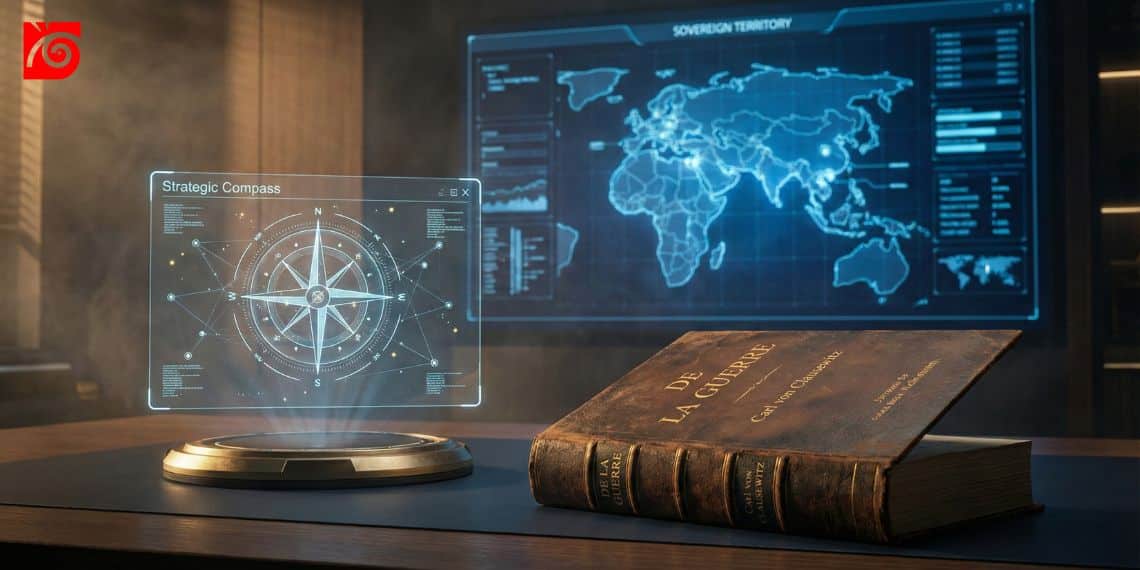
The defense market is not a commodity business; it is a Zweikampf, a duel of wills where technological excellence is merely ammunition. Without a brand doctrine to guide it, this power evaporates in the fog of competition and regulations. For BITD leaders, image strategy must move out of the communications department and into the operations center. By applyingClausewitz's Trinity to your governance, we transform your identity into an unassailable center of gravity. Here's how to win the war of perceptions before the first contract is even signed.
The French defense industry is experiencing a historic paradox. While threats are rearming and budgets are skyrocketing, manufacturers' freedom of action is being hampered by intangible forces: public pressure, banking reluctance under the guise of ESG, and a fierce war for talent.
Carl von Clausewitz taught that " war is an act of violence intended to compel the adversary to carry out our will." In 2026, this compulsion is no longer exercised solely through the product, but through legitimacy. Your brand is the instrument of this legitimacy.
Clausewitz defines his famous "Trinity" as the balance between three forces. For a BITD company, survival depends on the alignment of these same three pillars applied to its image:
Emotion and Passion (The People): This is the commitment of your employees and the perception of the public. Without this foundation, your "license to operate" is threatened by activist movements or a loss of interest among young engineers.
The Game of Probability and Creativity (The General): This is the talent of your agency and your marketing teams to navigate media uncertainty, create captivating narratives, and stand out in a crowded trade show.
Political Reason (The State): These are your business objectives and industrial consistency. This is where the Governance Foundation lies.
The major risk: A company that focuses solely on technology (reason) without nurturing its narrative (emotion) ends up isolated. A company that focuses solely on communication (the general) without a strategic foundation (the state) collapses at the first sign of crisis.
The Schwerpunkt (Center of Gravity) is where force must be concentrated to achieve maximum effect. For a defense contractor, this center of gravity is not "what you sell," but "the promise of security you guarantee."
Many SMEs and mid-sized companies in the defense sector suffer from a diffuse center of gravity. They present themselves as "suppliers of high-precision solutions." This is a description, not a strategy.
The Autour de l’Image approach: We identify your unique strategic asset—whether historical (heritage), technical (disruption), or geographical (local sovereignty)—and make it the centerpiece of your brand narrative.
A brand with multiple and contradictory messages is like an army with overly long supply lines: it wears itself out. Every dollar spent on communication must feed into your Schwerpunkt. If your visual identity dates back to the pre-digital era, you are sending troops into battle with obsolete equipment. The friction is immediate: a loss of credibility with international buyers.
Clausewitz was the first to theorize friction: "Everything is very simple in war, but the simplest thing is difficult." In defense communication, friction is called:
Banking “de-risking ”: Institutions refusing to finance the defense industry for fear of damaging their own image.
Disinformation: Campaigns orchestrated by foreign powers to discredit your solutions.
Regulatory complexity: European standards that ignore the specific nature of combat.
Leaders must possess what Clausewitz calls " Coup d'œil ": the ability to see clearly amid chaos. A brand strategy guided by the Governance Framework prevents emotional reactions to every controversy. It provides a clear path forward.
Concrete example: Faced with a media attack on the ethics of its exports, a brand that has already invested in the field of "Sovereignty and Protection of Democracies" has a pre-installed narrative shield. It does not defend itself, it reiterates its mission.
Clausewitz asserts that defense is the strongest form of combat. Before launching an offensive (conquering new markets, acquiring competitors), you must secure your base.
In the BITD, your "domestic market" is your reputation with the DGA, military headquarters, and your employment pools.
Recruitment as a defensive operation: If your brand is not strong enough to attract the best cyber or mechanical experts, your production lines (your front line) will weaken.
Influence as preventive artillery: Occupying media space and LinkedIn is not a vanity exercise. It is artillery preparation that sets the stage for your sales forces.
| Clausewitzian concept | Application to Defense Marketing |
| Fog of war | Uncertainty related to political changes and public opinion. |
| Friction | Resistance from banks, NGOs, and HR. |
| Rising to extremes | Intensification of global competition (USA, China, Turkey). |
| Freedom of action | Ability to choose partners and markets without image pressure. |
Strategy is only as good as its execution. For Clausewitz, the leader's will is the driving force behind everything. But this will must be supported by a structure.
In a BITD company, communication cannot be a satellite. It must be integrated into governance. That is the essence of our Strategic Compass offering.
Staff Vision: We align your brand identity with your 10-year sovereignty goals.
Tactical consistency : We ensure that every communication (website, annual reports, social media) is consistent and aligned.
Strategic Resilience : We prepare your brand to withstand shocks (reputation crises, changes in political majority).
Victory, in marketing as on the field, belongs to those who set the rules of the game. By structuring your brand around an unshakeable foundation of governance, you impose your narrative on the market. You no longer suffer perception, you command it.
Withdrawal is no longer an option for the defense industry. As Clausewitz pointed out, "a purely defensive attitude is contrary to the idea of war." It is time to go on the media and narrative offensive.
Your technology is your kinetic force. Your brand is your driving force. Without the latter, the former is wasted.
The Autour de l'Image Governance Framework is designed for leaders who refuse to let chance dictate their positioning. It is the logical response to the growing complexity of BITD.
Take the strategic initiative. Don't let the fog of media warfare obscure your excellence.




