
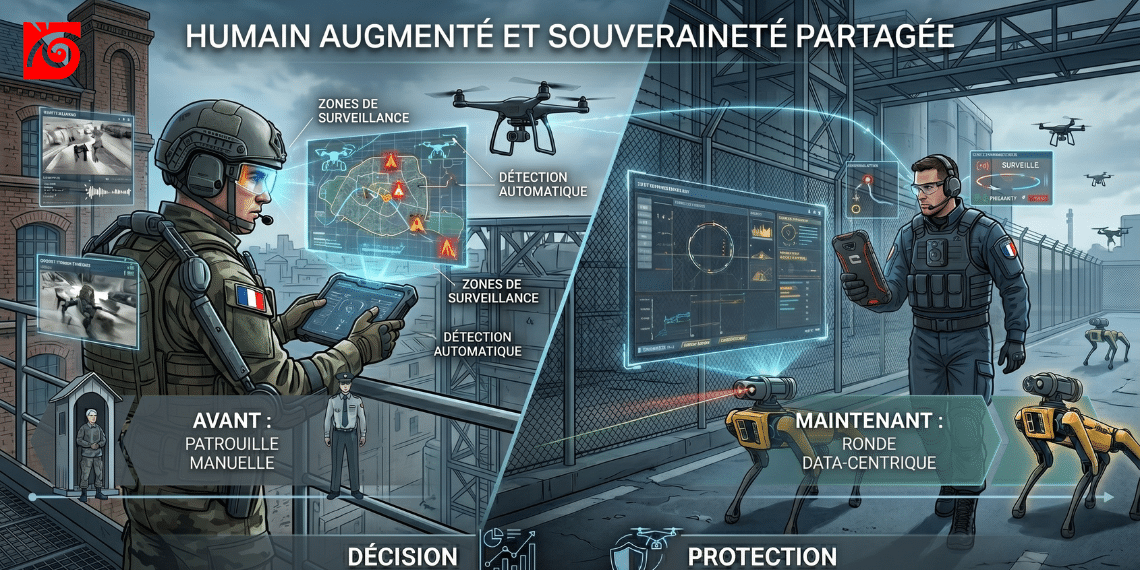
Technological acceleration is redefining the rules of engagement. Faced with rapid, hybrid threats, the defense industry and the private security sector now share a common imperative: to move beyond a mass-based approach and embrace the data-driven era. Whether you’re operating in a foreign theater or securing critical infrastructure, understand how the shift toward augmented humans is transforming your operational models —and why this transformation requires a reimagined strategic governance framework.
Historically, warfare and security evolved over decades. Doctrines were developed over the long term. Today, they change every few months. Whether you are deploying forces to a foreign theater of operations or protecting a Critical Infrastructure Operator (CIO) on home soil, the reality is undeniable. The nature of the threat has changed. It is hybrid, fast-moving, asymmetric, and highly technological.
In response to this reality, the defense industry and the private security sector are undergoing exactly the same transformation. Both sectors are moving away from a mass-production approach to embrace the era of data, artificial intelligence, and robotics. Their shared goal: to create “augmented humans” in the service of national sovereignty.
Yesterday’s capacity-based model relied on extremely long production cycles. Engineers designed tanks, frigates, and fighter jets intended to dominate the battlefield for thirty or forty years. Superiority was achieved through sheer numbers and mechanical robustness.
Modern conflicts, from Eastern Europe to the Middle East, have shattered this paradigm. The reality on the ground proves that even state-of-the-art technology can be circumvented and rendered obsolete in a matter of weeks. In the face of the rise of low-cost drones, cyberattacks, and electronic warfare, bulkiness has become a vulnerability. The 2024–2030 Military Programming Law (LPM) acknowledges this shift by allocating massive budgets not only to “hard power” but also to digital capabilities, intelligence, and rapid innovation.
The defense industry must now constantly reinvent itself. Innovation is no longer just a phase of the design process; it is an ongoing process.
Three areas currently dominate military R&D:
The proliferation of autonomous systems: The ubiquity of tactical drones is changing the nature of operations on the ground and fueling a frantic race toward anti-drone capabilities (ADC).
Massive data processing: The battlefield generates petabytes of data. The challenge is no longer to collect information, but to use AI to sort through it and provide insights to command.
The Invisible War: Influence, counter-influence, and cyber defense strike even before the first shot is fired.
The modern soldier is no longer merely a physical executor. He has become a hyper-connected data sensor and processor, integrated into a global tactical network.
This technological upheaval is mirrored exactly in the civilian sector. Historically, the private security market has been structured around a purely quantitative model. You sold “hours” and “manpower.” Static guarding—relying solely on the physical presence of a single agent—was the norm.
This model has reached its limits. Economic pressure on margins and the increasing complexity of risks make the “all-human” approach unsustainable. Today, security guards are undergoing an internal revolution: they are no longer alone. They are becoming the nerve center of a comprehensive technological ecosystem.
| Analysis criteria | Traditional security model | New Technological Paradigm (Augmented Agent) |
| Sale price | On-site presence; security guard hours billed. | Hybrid human-machine ecosystem, comprehensive security. |
| Operational posture | Reactive (post-incident response, investigation). | Proactive (AI-powered detection, predictive analytics). |
| Officer's equipment | Analog radio, paper logbook, telephone. | High-speed connected devices, real-time data streams. |
| Field coverage | Limited to the immediate field of view of the isolated agent. | Comprehensive and augmented (drones, algorithmic cameras). |
To ensure the integrity of critical sites, security firms are now deploying a range of tools directly derived from defense technologies:
Critical broadband communications: No more overloaded radio networks. Solutions like Agnet (developed by Airbus Public Safety and Security) offer secure communications, live video sharing, and precise geolocation, connecting officers to the Command Post (CP) in real time.
Robotic and aerial support: Perimeter patrols are supported by tethered or autonomous drones (such as the French NX70 ), as well as by ground patrol robots (such as the GR100 from Running Brains). They cover high-risk areas without putting personnel at risk.
AI-powered vision: Video surveillance networks no longer simply record footage passively. Powered by deep learning algorithms, cameras detect abnormal behavior, line crossings, or abandoned objects, enabling rapid resolution of incidents. Perimeter surveillance is now provided by cameras such as Reconeyez, which offer 100% reliable intrusion detection.
In the face of this rapid digital transformation, one fear persists: that humans will be replaced by machines. This is a complete misunderstanding. Contrary to popular belief, AI and robotics do not replace soldiers or security guards. Instead, they redefine their roles around two fundamental pillars.
The machine takes on the cognitive load associated with routine monitoring. It filters out noise so that only anomalies are flagged. Humans can then refocus on what they do best: complex contextual analysis, ethical judgment, and final tactical decision-making. The goal is to have the right information, at the right moment, to neutralize the threat before it strikes.
This is the key challenge of this technological continuum. Sending a drone to investigate a sensitive chemical site or using a robot to inspect a suspicious package eliminates the risk of direct exposure. Technology acts as a shield. It takes on the physical risk to protect soldiers and agents.
There is no longer a clear-cut boundary between military R&D and innovation in civil security. These two fields are converging toward a single model: that of humans enhanced by data. Whether it’s the military protecting our borders or security personnel safeguarding our critical infrastructure, the approach is the same and the goal is shared: to protect the nation against hybrid threats.
However, simply piling on technologies is not enough to guarantee security. Any organization can purchase drones and artificial intelligence software. Successfully integrating them into a coherent, cost-effective, and sovereign operational model is an entirely different matter. This paradigm shift is not just a technical issue; it is a major strategic challenge.
To transition from a cost center (selling hours) to a value center (selling enhanced security), your company must reinvent itself from the inside out. Your decision-making processes, your business model, your teams’ training, and your management culture must align with this new technological reality.
This is where strong governance makes the difference between companies that are merely subjected to innovation and those that use it as a driver of growth.
Ready to plan your transformation?
Technology is just a tool; strategy is your compass. Discover how to set a clear course and align your business model with the demands of tomorrow’s market through our dedicated expertise: The Governance Framework.




