
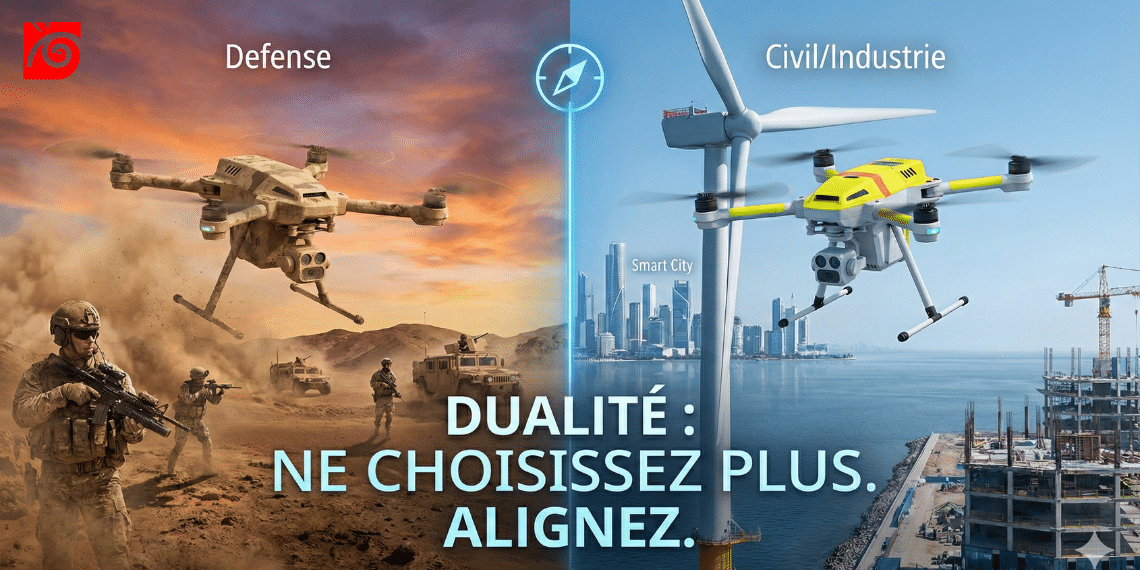
The trap of division: Creating two separate brands for Civilian and Military often dilutes overall impact and creates costly internal confusion.
The "Overkill" effect : A "Combat Proven" sales pitch reassures a General but may scare a civilian manufacturer who fears over-complexity and maintenance costs.
The root narrative: The solution lies not in technical vulgarization, but in identifying a higher mission (the "Why") common to both worlds.
Commercial alignment: A clear Strategic Compass enables your sales teams to adapt their pitch without ever compromising the fundamental identity of the company.
The halo of reliability: When well orchestrated, military requirements become a guarantee of peace of mind for civilians, transforming robustness into an industrial competitive advantage.
The defense market is your birthplace. Robustness is your signature. Yet when it comes to conquering the civilian market to scale up, the machine grinds to a halt. The rhetoric that fascinates operational staff in the field leaves industry CIOs cold. Should you split your soul in two? Absolutely not. This article explores how to transform this apparent duality into a unique growth engine by aligning your vision to appeal to the private sector without ever denying your combative DNA.
You have combat-proven technology. This label, "Combat Proven, " is your pride and joy. It tells the story of sleepless nights, resistance to thermal shocks, and absolute reliability when lives are at stake. It is your passport to government markets.
But to reach €50 or €100 million in revenue, the defense market is no longer enough. You have to tackle the civilian or industrial (B2B) market. That's where the wall stands.
Paradoxically, what makes you strong in the eyes of a general (secrecy, extreme specifications, sovereignty) becomes a turn-off for an industrial director. The latter is not looking for survival, but for ROI. He doesn't want something "indestructible," he wants something "efficient and maintainable."
Faced with this dilemma, there is a strong temptation to develop a split personality. This is the beginning of strategic schizophrenia.
The most common mistake made by champions of deep tech or dual-use robotics is to think that technical superiority is enough on its own.
Imagine an armored vehicle that is painted bright yellow to sell it to a construction company, without changing the engine, fuel consumption, or ergonomics. This is often what happens with marketing rhetoric.
We are clumsily attempting to "civilize" a military offering. We are removing warlike terms and adding photos of construction helmets, but the structure of the offering remains unsuitable.
The Defense customer purchases operational capability and resilience. The cycle is long, political, and based on specifications.
Civil customers buy profitability, ease of use (UX), and service. The cycle is transactional and comparative.
If your strategy is simply to tone down your military rhetoric, you are sending a signal of "over-engineering." Civilian prospects immediately interpret this as: "It's too expensive, too complex, and I'm going to pay for features I don't need."
To counter this, some companies create two separate entities: a "Navy" brand and an "Industry" brand. In the short term, this seems straightforward. In the medium term, it's an operational nightmare:
Dilution of resources: You have to feed two marketing machines.
Internal confusion: Your engineers no longer know who they are designing for.
Loss of power: You deprive yourself of leverage. The reputation gained in theaters of operations does not sufficiently benefit civilians.
To break this deadlock, we must not seek the lowest common denominator between civil and military (which is often bland), but look higher. We must define our fundamental raison d'être. The one that is true, regardless of who signs the check.
Let's take a concrete example. Imagine that you manufacture land drones.
Speech A (Military) : "Tactical mine-clearing robot resistant to IEDs."
Speech B (Civil): “Industrial pipe inspection robot.”
Both of these arguments focus on the product. They are incompatible. Now, let's apply a Strategic Compass to find the root mission:
“We provide the ability to intervene and act where humans cannot go.”
This value proposition is universal.
For the military, this means: "Saving soldiers' blood."
For manufacturers, this means: "Protecting technicians and reducing production downtime."
The technology (the how) may change slightly, but the promise (the why) remains the same. You are no longer selling a robot; you are selling the projection of capability in hostile environments.
Once this strategic backbone is in place, how can it be rolled out? This is where the agency's expertise comes into play to structure the brand architecture.
Don't hide your military origins. Instead, reframe them. For an industrial customer, "Combat Proven" should translate to "Industrial Grade Reliability." If your equipment has survived the sand of the Sahel, civilian customers will intuitively understand that it will survive the dust of their logistics warehouse. The message is no longer "It's a weapon," but "It's tireless." Robustness becomes a guarantee of service continuity.
This is often the most overlooked aspect. Your sales teams need to feel like they belong to one company. When the strategy is clear (the Compass), a sales rep can go from a meeting with the CEO to a call with an oil company without changing their personality. They simply adapt their vocabulary, not their conviction. They know they are selling the same excellence.
A successful dual strategy uses the victories of one to fuel the other:
The volume of the civilian market makes it possible to lower industrial costs (which delights government buyers).
The technological demands of the military finance disruptive R&D (which provides civilians with innovations that they could not have afforded on their own).
Trying to please everyone is the best way to become invisible. In the dual technology sector, success does not come from separating worlds, but from merging them around a strong vision.
Don't be a company that sells "military stuff and civilian stuff." Be the undisputed expert in a specific field (night vision, autonomous robotics, secure communications), capable of applying your excellence to different contexts.
This clarity cannot be invented during a Monday morning sales meeting. It has to be built. It requires stopping, looking at the compass, and charting a unique course.
Do you feel the tension between your two markets? Do you feel like you're diluting your message or exhausting your teams by "changing hats" several times a day?
The problem isn't your technology, it's your alignment.
At Autour de l'Image, we have developed a method to clarify this central vision. With The Strategic Compass, we help you define the unshakeable foundation that will drive your growth in all your markets, without schizophrenia.
Your technology is dual, your strategy must be unique.




