
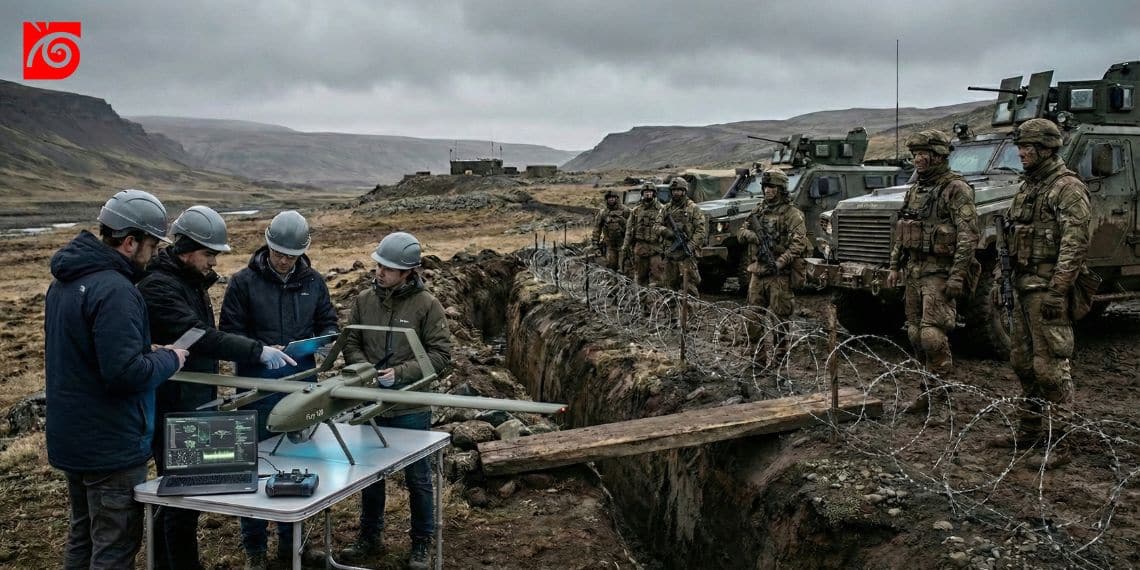
Many innovators imagine that walking through the doors of NATO or a Department of Defense is an end in itself. They arrive with serious funding, cutting-edge technology, and one certainty: "we have the solution." However, the reality on the ground is a graveyard of brilliant ideas that never survived their encounter with power structures, technical legacies, and the brutal demands of war. What is known as the "Valley of Death"is not simply a lack of funding, it is a seismic fault between the agility of the BITD and the vital inertia of sovereign institutions. To succeed, it is no longer a question of "disrupting," but of building resilience capable of withstanding the weight of history and human responsibility.
Enthusiasm is a poor compass in hostile territory. In recent years, the defense ecosystem has become a gold mine for venture capital funds and DeepTech startups. But behind the bright lights of trade shows such as Milipol, Eurosatory, and the Defense Innovation Forum, a harsh reality remains: most of these "revolutionary" solutions end up fading away into the silence of administrative corridors.
Why? Because defense is not a market like any other. It is a world where mistakes are not paid for in "churn rates," but in human lives.
This analysis is inspired by a publication by Eva Sula that appeared on January 31, 2026.
In defense, trust is the foundation of everything. It cannot be decreed during a Zoom demo. It is deeply personal, built on years of constant presence, shared merit, and understanding of doctrinal issues.
There is no such thing as rapid scaling in defense. You have to be there: in NATO exercises, in obscure working groups, in difficult conversations about what happens when the system breaks down.
Physical presence: This is non-negotiable when it comes to gaining credibility. A good example of this is Shark Robotics. Deployed inside Notre Dame Cathedral in 2019 during the fire that ravaged the building, Shark's teams are now in Ukraine saving lives.
Continuity: Decision cycles often extend beyond the duration of a fundraising campaign.
Expert opinion: “Trust is built between people who have learned to rely on each other in times of crisis. You can't bypass this process with aggressive marketing.” — Eva Sula.
Many people talk about defense without understanding the reality of combat. War is not an abstract concept or a clean simulation. It is total uncertainty, degraded communications, and extreme pressure.
The conflict in Ukraine has acted as a distorting mirror for our technological certainties. What survives on the battlefield is not necessarily the most complex system, but the most robust.
| Feature | Innovation Lab | Combat-Ready Innovation |
| Priority | Optimization & Speed | Resilience & Redundancy |
| Maintenance | Dedicated technical support | Repairable in the field by the operator |
| Connectivity | Cloud & High Fidelity | Gradient mode & Anti-interference |
| Evolution | Quarterly update cycle | Daily adaptation in response to the opponent's counterattacks |
If you design an elegant solution that requires a perfect satellite connection to function, you have designed a target, not a tool. Innovation in defense must accept "friction" — that Clausewitzian concept where everything simple becomes difficult.
One of the most costly mistakes is to believe that NATO is a single customer. NATO is a system of 32 sovereign nations, each with its own priorities, budgets, and laws.
You operate simultaneously in several dimensions:
The strategic level: The Alliance's deterrence concepts.
The institutional level: The European Defense Agency (EDA) or the European Commission.
The operational level: The immediate needs of forces in the field.
The industrial level: Partnerships with "Prime Contractors" (Thales, Airbus, Lockheed Martin), which often hold the keys to integration.
Ignoring even one of these layers means ensuring that your innovation will remain a short-lived "experiment." Adoption is not a single step, but rather a long-term political and legal process.
Most failures do not occur because the technology is bad, but because it is "unadoptable."
Integration: How does your AI connect to a 30-year-old system?
Data governance: Who owns the data? Who is responsible in the event of an algorithm error?
Sustainment: Who will maintain your system in 15 years when your startup may have been acquired?
Scaling requires understanding thatlegacy systems are not going to disappear. Success does not come from abrupt replacement, but from the ability to make the old and the new interoperable.
Crossing the Valley of Death is not a question of speed, but of structure. To succeed in defense, you must build solutions that are not only technically brilliant, but institutionally acceptable. This requires patience, humility, and above all, a clear strategic vision.
In such a complex ecosystem, agitation too often replaces leadership. For a company that wants to succeed, technology is only the fuel. The engine is your strategy.
At Autour de l’Image, we know that to overcome defensive barriers, you must first strengthen your Governance Foundation.
Why? Because before pitching NATO, you must:
Define a vision that aligns with geopolitical realities.
Structure your organization to meet security and sustainability requirements.
Build authority that reassures decision-makers about your ability to deliver in the long term.
Without this foundation, you are just another tourist in Death Valley. With it, you become an indispensable strategic partner.
Would you like us to analyze together the strength of your strategic positioning for sovereign markets?




