
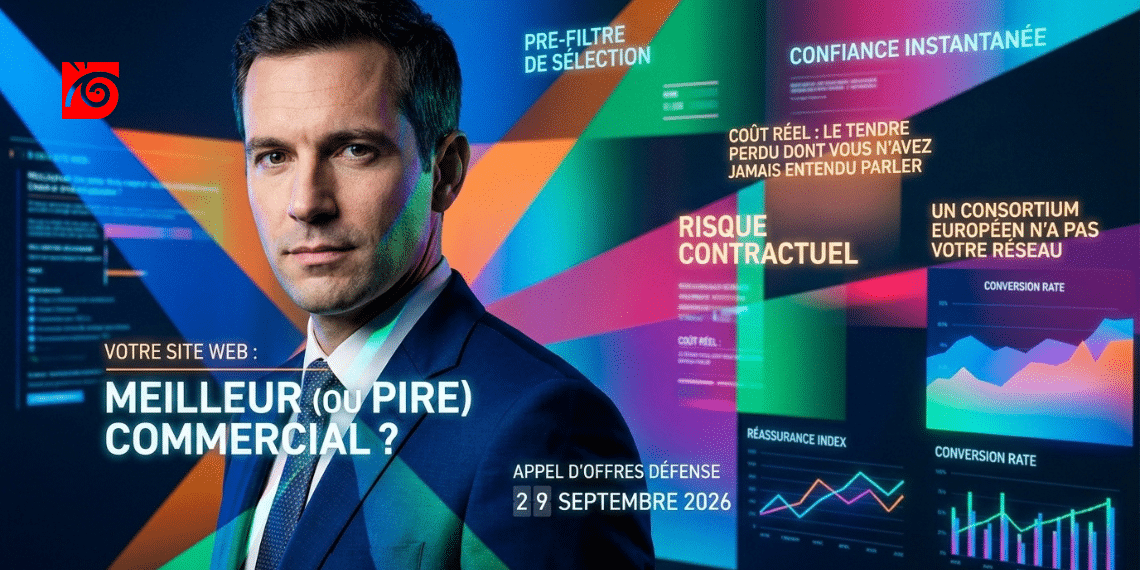
You have eight days left. The consortium isn’t set in stone yet; the German and Polish partners are still on the fence, and no one will ever tell you this: what turned them off wasn’t your technology—it was the homepage they opened before the first Teams call . In the defense sector, technical excellence isn’t visible from the outside. Credibility, however, is . And it’s judged in a matter of seconds, on a platform that most SMEs in the BITD sector still view as a passive showcase. This article breaks down this process, step by step, and guides you through the trade-offs you’ll need to make when the deadline is just a week away.
Your website runs around the clock. Without you, without a filter, without the right of reply.
He receives visitors you’ll never see in your CRM: a project manager from a German cluster looking for a French SME specializing in sensors, a partnerships manager from a Polish mid-sized company putting together a technical funding round, and a buyer checking out a recommendation received at a trade show.
The timeline makes this an urgent matter. The European Commission has launched the European Defense Fund’s 2026 work program, which includes 10 calls for proposals totaling 1 billion euros, with a submission deadline generally set for September 29. The consortium rules remain the same: at least three independent entities from three Member States or associated countries, though disruptive technologies require only two. In other words: with just a few days left before the deadline, dozens of consortia are solidifying their structures, reorganizing, and seeking replacement partners.
When it comes to defense, your website isn't a showcase. It's a preliminary screening tool that you don't control.
The actual process is disconcertingly mundane. Your name is mentioned in a meeting. Your name is read from a tape. Your website is opened. A decision is made.
This mechanism is extensively documented in the B2B sector. Despite shorter cycles and earlier engagement, nearly 80% of conversations are initiated by the buyer, and the supplier contacted first wins 8 out of 10 deals. The buyer spends most of their journey conducting independent research, which involves making a preliminary selection of suppliers before any contact is made. You’re not trying to convince them during the call. You’re being evaluated—or eliminated—before that happens.
And people form judgments even faster than you might think. Three studies have measured how quickly people form an opinion about a web page: visual appeal is assessed in 50 milliseconds. You don’t have eight seconds to convince someone. You have eight seconds to avoid being dismissed, and one-twentieth of a second for that first emotional verdict. We detailed this mechanism in our analysis of the 8-second test applied to defense SME websites .
The defense adds two layers of intransigence:
The typical scenario we encounter regularly: an SME that excels in its niche, with two patents, a successful proof of concept, and a website that talks about “innovative solutions designed to boost performance.” It wasn’t ruled out. It was never even considered. This is exactly the mechanism we describe in our work on the contracts that SMEs in the BITD sector lose due to a lack of visibility .
| Signal | What you think you're showing | What People Are Reading |
|---|---|---|
| Freshness | A Low-Key News Story | "Latest news: 2019. Are they still active?" |
| Proof | Discretion Imposed | "No references, no clients, no programs" |
| Clarity | A wide range of offerings | "I don't know what they're doing or for whom." |
| Requirement | A site that's good enough | "No English, no certifications: not ready for Europe" |
| Accessibility | A contact form | "Who makes the decision? Who should I call before Friday?" |
Freshness is the most underestimated indicator. An abandoned blog, an outdated copyright notice, a “About Us” page listing people who no longer work there—these are signs of inactivity, not discretion.
Evidence is the key to success. Can’t name a government client? You can describe a work environment, an operational constraint that’s been resolved, or a TRL level that’s been achieved. Experience feedback is a business asset, and it’s being wasted on a massive scale: we’ve conducted a comprehensive analysis of it for SMEs in the BITD .
Clarity is the breaking point for dual-purpose companies. When a visitor can’t distinguish between your civilian and defense operations, they won’t make the effort to decide for you. This lack of clarity has a measurable cost, which we document in our civil/defense dual positioning assessment .
The perceived requirement comes down to institutional details: a properly formatted English version, qualifications, membership in a cluster, and mention of European programs. Entities must be established within the EU and not controlled by ineligible third countries, except under strict conditions. : A partner will first verify with you what Brussels will require them to prove.
Accessibility—finally. A designated contact person who is reachable and has a clearly defined role. With eight days left until the deadline, this is sometimes the only deciding factor.
This is where the asymmetry becomes stark.
A DGA buyer might know you from the field, through a proof of concept, or through an innovation hub. A Finnish or Czech partner has none of that. All they have is your website and your LinkedIn profile. In fact, executives’ online silence has a direct cost on contracts, which we’ve quantified in our analysis of the LinkedIn silence of BITD executives .
The stakes are high. The 2026 work program covers 31 topics, organized into seven thematic calls, three non-thematic calls, one action on hypersonic gliders, and two actions in support of the Alliance for Medical Countermeasures. Approximately 60 million euros are earmarked for disruptive technologies, and 60 million for non-thematic calls dedicated to SMEs. For those who manage to secure a place in a three-country consortium, research projects are funded up to 100 percent, and the SME bonuses significantly increase the funding rate for development projects.
Note the French process: Before any submission to Brussels, development projects led by SMEs must be presented to the DGA via a preliminary proposal submitted by May 29, 2026, to secure the financing structure and verify the consortium’s eligibility. The national screening takes place early in the process. The final week, therefore, is not about convincing the government—it’s about locking in the partners. A proposal that raises doubts will cost you precisely at this stage.
Hidden costs are, by their very nature, invisible: no one writes to tell you that they've decided not to contact you.
The shift is mental before it is technical. A storefront is judged on its aesthetics. A salesperson is judged on their conversion rate.
What we’re seeing among small and medium-sized businesses that are making this shift is that they’re no longer trying to overhaul everything. They’re setting priorities.
Four commendable actions in less than ten days:
The competitive landscape will leave you no room to breathe. With more than 5 billion euros in purchases made by and from over 26,000 small and medium-sized enterprises (SMEs) and mid-sized companies, the Ministry of the Armed Forces’ procurement contracts represent a major driver of growth. You’re just one name among tens of thousands. The selection process is by elimination, and it starts online.
It’s not the lost bids that weigh heaviest on your record. It’s the ones you never even heard about—because your name was crossed off the list before the first round of discussions even began.
This loss is silent, recurrent, and completely reversible.
September 29 will come and go. Other deadlines will follow. So the issue isn't about saving a file, but about no longer being filtered by default.
That is exactly the purpose of the Capital Confiance & Expérience : reshaping the first impression your company makes throughout the entire customer journey, so that perceived quality finally matches actual quality. We analyze what a buyer or partner sees in the first eight seconds, then correct the signals that are costing you business opportunities.




