
Scaling up on a massive scale: The goal of 40,000 drones per year in Charente-Maritime to address the urgent needs on the front lines.
The “Deep Freeze” Test: Why technical validation under extreme conditions is the ultimate test of industrial reliability.
“Plug-and-Fight” AI : How Alta Ares Integrates Artificial Intelligence to Make Its Systems Resilient to Electronic Jamming.
NATO's Seal of Approval: How Winning the NATO Innovation Challenge Boosts the Brand's Global Credibility
Agility vs. Inertia: Why Alta Ares Succeeds Where Defense Giants Struggle to Adapt
The conflict in Ukraine has revealed a brutal truth: our traditional arsenals are ill-suited for mass drone warfare. Between operator burnout and dwindling missile stocks, European defense faces a major capability gap. Alta Ares doesn’t just offer a technical solution; it demands a paradigm shift. Through its Black Bird drone and Pixel Lock AI, this French rising star is transforming “suicide mission” interception into industrialized flow management. Discover how this brand strategy, forged in the mud of the Donbass, is redefining the rules of technological sovereignty.
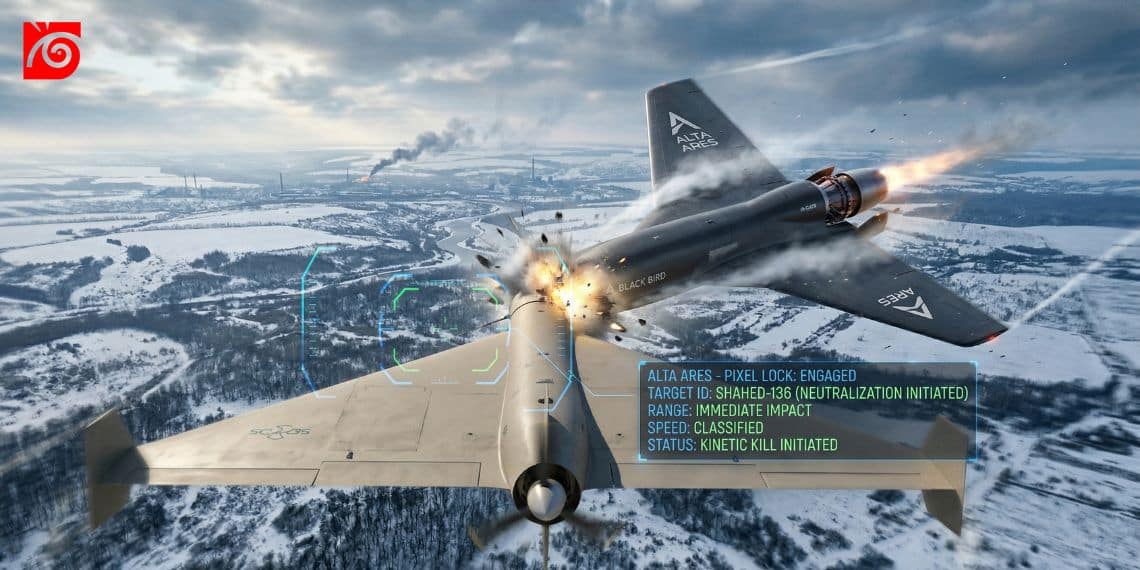
The image has gone viral in defense circles: a jet-powered interceptor drone closes in on a Shahed-136 at over 500 km/h, taking it down in a matter of seconds. This isn’t a video game simulation, but a typical day in the life of Alta Ares’ operational tests.
As geopolitical tensions escalate, the French startup is emerging not merely as a supplier, but as an architect of the new “mass” doctrine. For Autour de l’Image, analyzing Alta Ares amounts to studying a brand strategy that has understood that, in modern defense, credibility is no longer built in Parisian salons, but through immediate feedback (RETEX) from the battlefield.
The French defense sector has long been dominated by twenty-year development cycles. Alta Ares has broken through that barrier in less than 24 months. By 2026, the company will no longer be content with simply manufacturing drones: it will be scaling up its response to the threat of mass aerial attacks.
The main challenge facing Western militaries today is economic. Using an Aster or Patriot missile to intercept a low-cost suicide drone is a financial absurdity that is unsustainable in the long term. The situation in the Iranian theater and the state of U.S. missile stockpiles have once again confirmed this.
Alta Ares has built its reputation on a simple promise: to restore financial balance to the defense sector. By developing systems such as the Black Bird, the company offers an interception cost that is one-tenth that of traditional surface-to-air systems.
| Defense system | Estimated cost per shot | Typical target |
| Surface-to-Air Missile (Medium Range) | €1,000,000+ | Aircraft, Cruise missile |
| Alta Ares Interceptor Drone | < 50 000 € | Kamikaze drone (Shahed, Geran) |
| Anti-aircraft gun (Cheetah) | High ammunition costs | Drone, Helicopter |
This approach is not merely technical; it is highly strategic. It enables decision-makers to design a “deep” and “dense” defense system capable of withstanding saturation attacks without draining national budgets.
One of the key lessons learned from the Ukrainian front is operator burnout. Alta Ares’ strategy is based on automating the final phase of an attack to transform the soldier from a “pilot” into a “supervisor.”
Using DRI (Detection, Recognition, Identification) AI, the drone autonomously classifies threats. This distinction makes all the difference: it allows a single operator to manage ten times as many drones simultaneously.
On the front lines, electronic warfare (EW) is ever-present. AI that relies on the cloud is dead AI. Alta Ares’ brand strategy is therefore based on data and execution sovereignty. Their algorithms, such as Pixel Lock, run locally (“Edge AI”) on the drone.
Why is it a strategic asset?
Full autonomy: The drone continues its mission even if the connection with the operator is disrupted by jamming.
Response speed: Local processing reduces latency, which is crucial for intercepting targets traveling at speeds exceeding 600 km/h.
Field training: Through its ML Ops platform, Alta Ares enables military forces to train their own models using classified data.
Technology is meaningless in the defense sector without rigorous validation. Alta Ares has built a “shield of credibility” by combining diplomatic success with technical resilience.
Alta Ares’ victory at the NATO Innovation Challenge in October 2025 served as a major boost to its credibility. More than just an award, it is a certification of interoperability. The Pixel Lock system was thoroughly evaluated by Alliance experts and deemed a “world first” for its ability to lock onto a target in a congested environment.
In February 2026, the company dispelled any remaining doubts by testing its drones in extreme cold. A drone that cannot take off at -10°C is useless on the Eastern Front. By demonstrating this durability, Alta Ares has evolved from a “technological gem” into a leading military equipment supplier.
The true revolution of Alta Ares lies not only in its aerodynamics, but in its ability to be produced on an unprecedented scale. This is where the startup enters the realm of “mass warfare.”
The opening of the factory in Charente-Maritime marks a turning point. The goal of producing 40,000 drones per year is an operational necessity to support the war effort and ensure Europe’s security. This model is based on two pillars:
Component sovereignty: By relocating production, Alta Ares is breaking free from its reliance on Asia for critical parts.
Design-to-cost: Each component is designed for quick assembly without compromising the precision of the turbojet engine.
The analysis highlights a crucial point: Alta Ares’s position outside the government’s conventional approach. While traditional organizations rely on rigid specifications, Alta Ares employs an iterative development process.
The bypass strategy: By first proving itself on the battlefield (the Ukrainian “testing ground”) and to NATO (the “guarantor”), it compels the French government’s interest through irrefutable evidence of success.
Alta Ares is proof that a high-tech brand can establish itself through a clear vision and practical execution. By transforming complex challenges—such as asymmetry, cognitive overload, and interference—into actionable solutions, it has earned the trust of even the most demanding stakeholders.
However, transitioning from an agile startup to a pillar of the European defense industrial and technological base (BITD) requires rigorous structuring. Such rapid growth cannot be sustained without robust governance capable of aligning the industrial infrastructure with the political vision.
A smooth transition to the governance framework
Just as Alta Ares had to refine its vision to win over NATO and scale up its production, your company needs a strategic roadmap to turn its innovations into lasting success. At Autour de l’Image, we believe that impact starts with a solid foundation.
Learn how our offering The Governance Framework can help you align your vision, strategy, and assets so that you, too, can become a key player in your market.




