
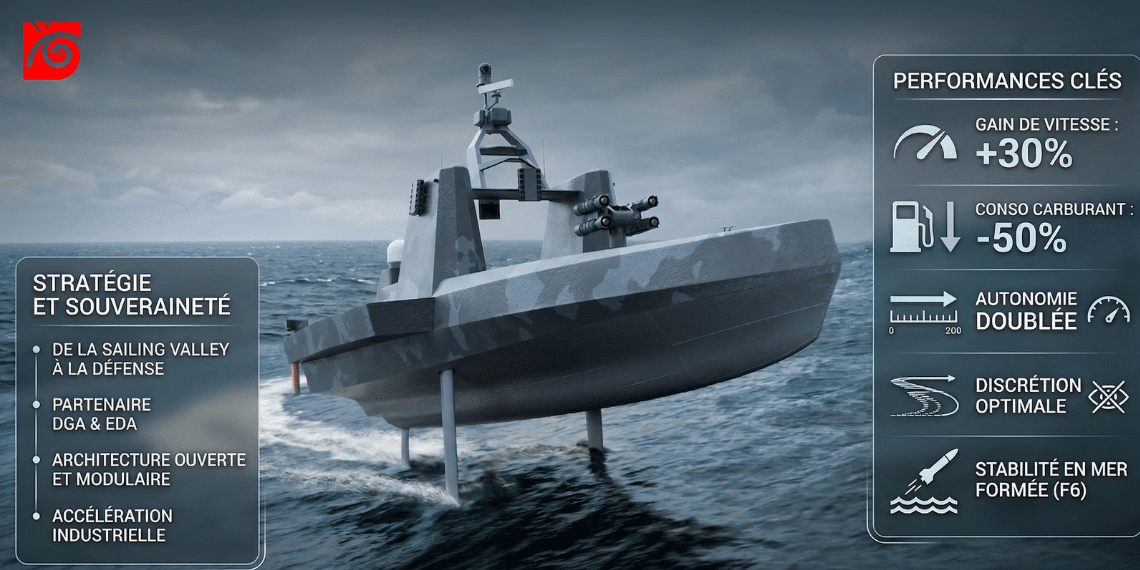
The conflict in the Black Sea has served as a wake-up call: naval drones are no longer just an option— they are the new cornerstone of maritime superiority. Yet most current platforms face a physical barrier: water resistance, which limits speed and drains batteries. In Lorient, the company SEAir Platforms has decided to break through this glass ceiling by making defense vessels fly. By combining aeronautics, artificial intelligence, and naval architecture, it is not merely innovating: it is redefining the rules of engagement at sea. A deep dive into a brand strategy where French technological excellence becomes an indispensable weapon of sovereignty, driven by decisive financial acceleration.
The history of technology is often a story of transfer. What begins in the urgency of war sometimes finds its way into civilian life; but for SEAir Platforms, the path was the opposite. It was amid the spray of offshore racing, where skippers strive to gain a few knots on high-speed sailboats, that the spark was ignited. Founded in 2016 in Lorient, at the heart of the Sailing Valley in Brittany, the company had only one obsession: to make foiling accessible to everyone.
Ten years later, the narrative has changed dramatically. The joy of skiing has given way to the demands of the Directorate General of Armaments (DGA) and theEuropean Defence Agency (EDA). This transition from the “jewel of the sailing world” to the “strategic partner of European navies” is a textbook example of strategic vision and industrial mastery.
To understand the rise of SEAir, you have to delve into physics. A conventional boat pushes water in front of it. The faster it goes, the greater the resistance. In contrast, a SEAir vessel “takes off.” Thanks to retractable foils and, above all, controlled (controlled by real-time flight sensors), the hull rises above the surface.
In special forces missions, noise and wake are the worst enemies. A flying boat doesn’t “chop” through the waves. It glides. The result: a radar and acoustic signature reduced to a minimum, and a virtually non-existent wake. It is this stealth, combined with a 30% increase in top speed, that has won over international elite units.
One of the main obstacles facing unmanned surface vehicles (USVs) is endurance. By reducing drag by 50%, SEAir enables two critical scenarios:
SEAir’s strength lies in its deep roots in the local community. In Lorient, the company benefits from a one-of-a-kind ecosystem where composite engineers, defense electronics experts, and exceptional sailors work side by side.
Since 2016, SEAir has been on a path of continuous risk reduction:
It is no coincidence that the European Defence Agency has entrusted SEAir with the development of a 12-meter drone for special forces. This reflects the recognition thatan agile SME can provide a technological building block that large corporations prefer to integrate rather than reinvent.
|
Feature |
Classic Platform |
SEAir Platform |
Operating Profit |
|
Consumption |
100% |
50% |
Double the battery life |
|
Stability |
At the mercy of the choppy waves |
Stable flight (controlled) |
Shooting accuracy / sensors |
|
Stealth |
Strong scent |
Minimal wake |
Increased secrecy |
|
Speed at sea 4 |
Reduced (shell impacts) |
Suspended (flight) |
Prompt response |
The SEAir Platforms website and its LinkedIn content demonstrate a high level of marketing maturity in the industrial sector. The focus is not on the “tool” (the foil), but on the mission : “Reinventing maritime mobility for defense”.
The goal now is to turn this technological breakthrough into global industrial dominance. This new phase of growth is driven by a flagship project: the development of a 12-meter surface drone specifically designed for Special Forces, under the auspices ofthe European Defence Agency (EDA). While this program has already secured an €8 million commitment from Europe, SEAir is currently finalizing an additional €2 million funding round to complete this strategic financing.
At the same time, the Lorient-based company is reinforcing its commitment to the local community by launching a fundraising campaign for €500,000 via SouvTech Invest, allowing French citizens to directly support national sovereignty. These resources serve as a catalyst for three major pillars:
Technical leadership, achieved by finalizing R&D on propulsion systems and foil control algorithms;
Industrialization, through scalable "open architecture" platforms;
The commercial rollout, including the hiring of specialized personnel to export its 9-, 12-, and 20-meter vessels worldwide.
For investors, this is an opportunity to gain a foothold in a French DeepTech company that is no longer content merely to innovate, but is already delivering results—with 16 vessels in service across four continents and the renewed trust of industry giants such as Thales and MBDA. SEAir is thus transitioning from pioneer to leading industrial partner, capable of meeting the most critical defense requirements through radically transformed maritime mobility.
The story of SEAir Platforms shows that technological innovation, however brilliant, is not enough to conquer a market as complex as the defense sector. What made the difference was the Governance Framework.
Richard Forest and his teams have managed to:
At At Autour de l’Image, we are convinced that the growth of an innovative company rests on this backbone. A clear vision prevents a company from spreading itself too thin, allows it to pick its battles, and aligns its brand messaging with its operational reality. SEAir’s current fundraising effort is not an end in itself, but the fuel for a leadership team that has successfully transformed a sailor’s intuition into a defense industry standard.
Are you developing a disruptive technology and looking to develop a strategy to break into government-controlled or international markets?
SEAir’s success starts with strong leadership and a shared vision. Discover how our offering “The Governance Foundation“ can become the foil that will help your business take off.




