
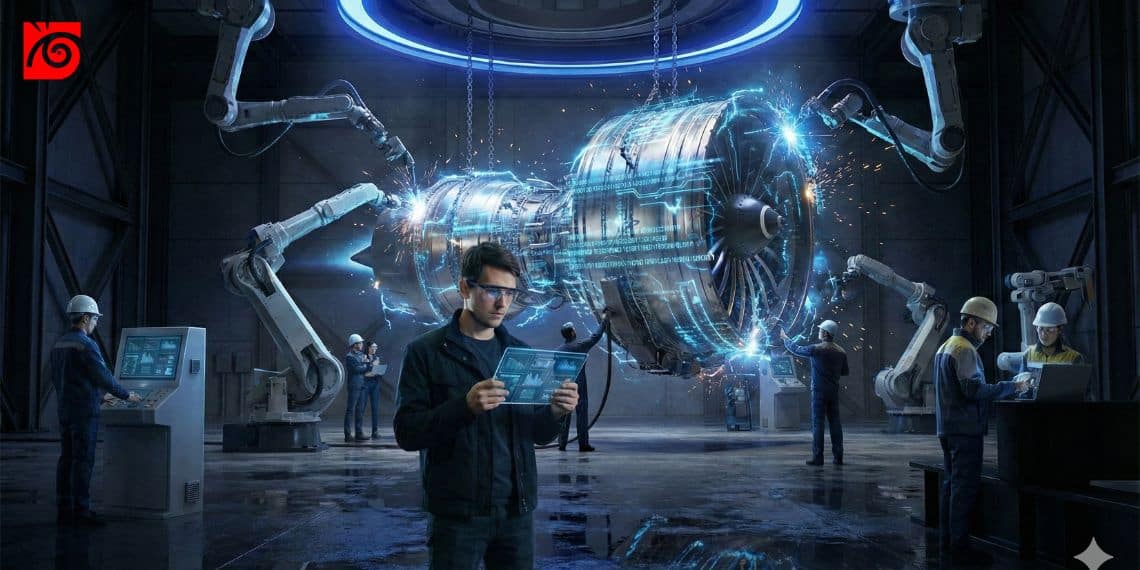
Your industrial SME must digitize in order to survive. However, attracting a data scientist or cybersecurity expert to the heart of Nouvelle-Aquitaine or Centre-Val de Loire seems like an impossible task given the appeal of Parisian startups. You've tried to play on their turf (foosball, hybrid teleworking), without success. What if you stopped apologizing for being an industrial company? You won't win by imitating Google, but by fully embracing what you are: the engine of the real world. Here's how to transform your industrial identity into a magnet for talent.
This is the cruel paradox of Industry 4.0.
On the one hand, you have cutting-edge machines, complex processes, and a vital need for artificial intelligence to optimize your production. On the other hand, the profiles capable of driving this transition (software engineers, data experts, system architects) seem allergic to industrial areas. They prefer to crowd into urban open spaces to optimize advertising click-through rates or develop meal delivery apps.
Faced with this, the typical reaction of industrial leaders is often defensive. They try to "look young." They renovate their offices and talk about "internal start-ups." This is a strategic mistake.
In this David versus Goliath HR battle, your slingshot is not comfort. It is Meaning.
Let's be clear for a moment. If your recruitment pitch is based on salary, meal vouchers, or office decor, you've already lost.
A startup raising funds (SaaS, Fintech) can always offer 20% more, shares (BSPCE), and a view of the city skyline. By trying to copy their codes, heavy or precision industries appear "old-fashioned" or "behind the times." It's like watching a banker try to speak slang: it sounds fake.
The tech talent you're looking for knows how to count. If they come to you, in Figeac, Pau, or Bourges, it's not for the financial package. They're looking for what Silicon Valley can no longer offer them.
There is a growing phenomenon among senior engineers and developers: the quest for tangibility.
After ten years of coding invisible algorithms for intangible services, many feel a sense of emptiness. What is my code for? To make people scroll longer? To sell consumer credit?
This is where the industry has a devastating advantage: reality.
In your factories, materials are transformed. They are forged, assembled, and machined. The code that this engineer will produce will not live in an ethereal cloud; it will control a robotic arm that moves tons of steel, or optimize the energy consumption of an electric arc furnace.
The compelling argument: "Here, your code has weight, temperature, and immediate physical consequences." For a logical and scientific mind, seeing the direct result of one's work is a dopamine-fueled reward far superior to a KPI dashboard.
This is particularly true for the defense, aerospace, and energy industries (the core target market for companies such as Ventana and Scrome).
For a long time, these sectors were timid, even shameful, hiding behind cold technical terms such as "precision engineering" or "tier 1 subcontracting."
It is time to change the narrative. The geopolitical context has changed. Industrial sovereignty is no longer a dirty word; it is a civic emergency.
A young engineer may hesitate to work for "an arms factory." But he will not hesitate to work for "a company that ensures our fighter pilots return home alive thanks to infallible optics."
The difference? Vision.
Technical version (boring): "We are leaders in the casting of light alloy engine blocks."
Vision (inspiring) version: “We forge the critical components that protect European airspace.”
The work is the same. The story we tell ourselves in the morning when we wake up is radically different.
This is where strategy meets HR. You can't just make this story up during the job interview. It has to shine through on every page of your website, every LinkedIn post, and every statement made by your CEO.
This is the role of the Strategic Compass.
At Autour de l’Image, we see too many manufacturers who have incredible expertise but a narrow view of their own value. The Compass is not a literary exercise. It is a management tool that defines:
The Mission (Why we exist): Beyond making a profit, what problem are we solving for society?
The Vision (Where we are headed): What kind of world are we building with our products?
Values (How we behave): Not keywords (“Innovation,” “Rigour”), but principles for action.
When these three elements are clear, recruitment changes in nature. You are no longer looking for a "C++ Developer (M/F)". You are looking for "A software architect to secure the French energy supply chain."
Let's take an SME that manufactures industrial valves.
Without Compas: Difficulty recruiting an R&D engineer. The company is seen as an "old polluting industry."
With Compas: The company is repositioning itself as a key player in the energy transition (its valves prevent methane leaks). The position becomes: "R&D Engineer for Industrial Decarbonization."
Result: It attracts candidates motivated by environmental issues, who are willing to leave Paris to make a real impact.
The war for talent cannot be won with weapons you don't have (millions from investors). It is won with what you have that is most valuable and inimitable: your heritage, your expertise, and the practical usefulness of your products.
Today's talents, whether they are 25 or 45 years old, are looking for a cause to serve. They want to know why they get up in the morning.
If you can articulate a clear vision, where technology serves a noble purpose (protecting, feeding, transporting, healing), you will no longer need to outbid others on salaries. You will attract those who want to build, not just code.
Do you feel that your company plays a crucial role in its sector, but your current messaging does not reflect this greatness?
Are your job postings attracting few or no suitable candidates?
The problem isn't your industry, it's the clarity of your direction.
Let's define your Strategic Compass together. We help you extract the "noble substance" from your business to transform your leadership vision into an irresistible driving force.




