
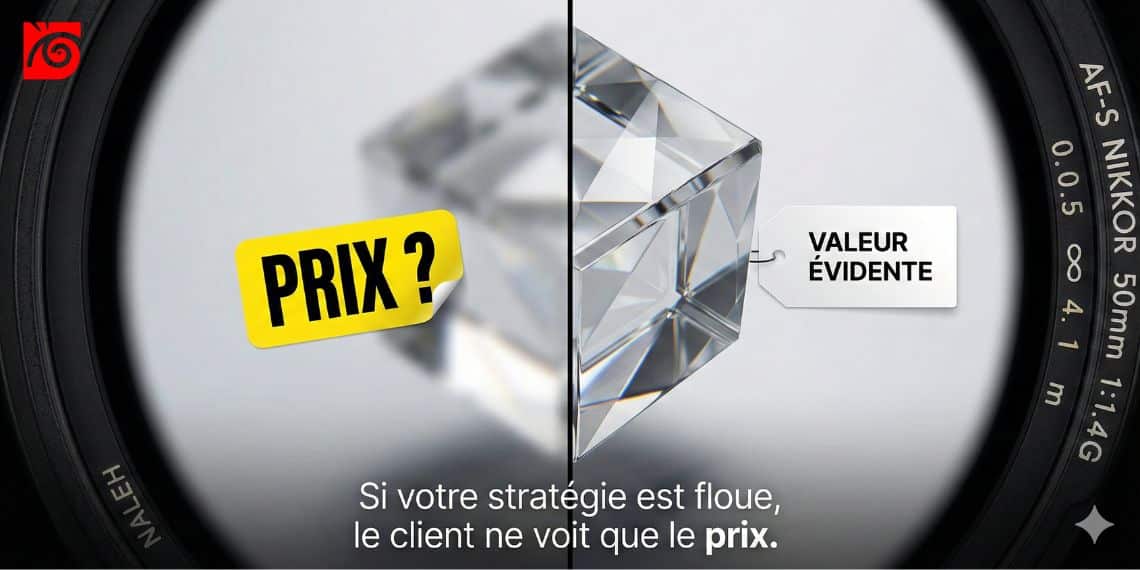
The "Flou" is a financial burden: It is not an abstract concept, but an invisible tax that weighs on your profitability at every level of the company.
Alignment Hemorrhage: Without a clear direction, your teams' energy turns into friction (stress) rather than momentum (growth).
The Decision Maker's Solitude: The lack of a clear vision forces you to micromanage and slows down your decision-making by half.
Direct Marketing Impact: A vague brand attracts "price" prospects and lengthens sales cycles; clarity attracts value.
The Resilience Tool 2026: Before cutting your budgets, invest in your "Strategic Compass" to ensure that every remaining dollar works in the right direction.
It's November. The Excel files for the 2026 budgets are open on all the executive desks.
In an uncertain economic climate, the instinctive reaction of managers is to look for areas to cut back on: marketing, R&D, recruitment?
This is a misdiagnosis. The real enemy of your margin in 2026 is not the amount of your expenses, but their dispersion.
Before cutting your budget, identify the "invisible tax" you pay every day: the Cost of Uncertainty.
It's decision-making season. For most of the SME and mid-market company executives we work with, the key question currently facing management committees is: "Where can we make savings to maintain margins in 2026?"
It's a legitimate question. It's also a dangerous question if asked too soon.
Why? Because it assumes that your current costs are optimized, but too high. However, in 80% of cases, the problem is not the cost of the action, but the cost of dispersion.
It is this astronomical amount of money, time, and energy lost because the company's direction is not absolutely clear to all employees.
Your challenge for 2026 is not to spend less. It is to stop funding chaos. Before cutting into the muscle of your business, let's analyze together the three major hemorrhages caused by flying by the seat of your pants.
The first financial manifestation of vagueness can be seen in your human resources. Not on pay slips, but in the actual efficiency of the work produced.
Take a look at your organization. Your teams are undoubtedly competent, committed, and full of good will. Yet you often feel like you have to play the role of "firefighter manager." You spend your weeks correcting mistakes, re-explaining things, and catching up on projects that have gone off track.
This is the classic symptom ofAlignment Bleeding.
Imagine your company as a physical vehicle. If you have 50 employees, each pushing with a force of 10, but in slightly different directions (due to a lack of a clear direction), the result is not 500. It could be 200, or even zero if the forces cancel each other out.
The difference between the energy paid (salaries) and the actual movement (results) is friction. And friction manifests itself as:
Projects redone three times.
Endless meetings to "reach an agreement."
Stress, burnout, and ultimately, turnover.
How much did this strategic project, carried out over six months by a marketing team that failed to understand that the commercial priority had changed, actually cost you? How much did the departure of this key executive, frustrated at seeing his energy diluted by contradictory orders, cost you?
A blurred vision transforms your human investments into heat (internal noise) rather than light (growth). In 2026, aligning vectors will be the most powerful economic measure at your disposal.
The second cost of "uncertainty" is more insidious: it affects your own productivity and that of your executive committee. This is the cost of loneliness.
Why? Because your managers don't have a "filter" to make decisions on their own. Without a Strategic Compass , they don't dare take initiatives for fear of stepping out of line. The result:
You become the bottleneck of your own company.
You're hesitating. Is this new offer "us"? Are we going into this market?
Decision-making time is getting longer.
In the economy of 2026, agility will not be an option, it will be a condition for survival. A company with a clear direction makes decisions twice as fast.
“Does this opportunity serve our mission?”
If so: let's go.
If not: forget it.
If the answer takes more than 5 minutes, it means your strategy is unclear. This constant hesitation creates deadly inertia. It paralyzes innovation and leaves the field open to more agile, more "clear-headed" competitors, who occupy the space while you are still in validation meetings.
Finally, internal strategic "uncertainty" always ends up being visible externally. It has a direct impact on your income statement (P&L). This is knownas brand hemorrhage.
If your direction is unclear to you, it will be unreadable to your customers.
Your marketing conveys lukewarm, generic messages that try to speak to everyone and touch no one.
Your salespeople struggle to justify your premium prices. They sell technical features, not a vision.
Your prospects do not understand your unique value proposition.
When perceived value is unclear, the only remaining criterion for comparison is price.
The "Cost of Ambiguity" manifests itself here in the form of lower margins. You are forced to compete on price when you should be winning on value. You attract lower-quality leads, which consume more sales time for a lower conversion rate.
Have you calculated the cost of a sales cycle that lasts four months instead of two, simply because the prospect is "hesitant" about your value proposition?
Preparing the 2026 budget cannot be reduced to cutting lines in an Excel file. This is a defensive approach that reduces your capabilities without solving the underlying problem. True performance will come from concentrating your existing resources.
We need to shift from a "spending" mindset to a "governance" mindset.
This is where the concept of Strategic Compass. At Autour de l'Image, we don't see brand strategy as a literary exercise to "look good" on the website. We see it as a financial management tool.
The Strategic Compass is the reference document that defines:
Your Why (Vision): To give meaning and energy.
Your How (Mission & Values): To guide behavior and autonomy.
Your What (Positioning): To stand out clearly in the market.
Investing in defining this course of action means stopping the three hemorrhages mentioned above:
Alignment: Every hour worked serves the common goal.
Decision: Governance is fluid, decentralized, and fast.
Commercial: The brand becomes a given for the market, justifying its value and margins.
In 2026, clarity will not be an intellectual luxury. It will be your main competitive advantage over competitors who are still flying blind.
The budgetary "quagmire" you fear is not inevitable. It is often the result of years of sedimentation, inconsistent opportunities seized, and diluted messages.
You have a choice for the coming year: Continue to fund ambiguity and compensate with effort? Or invest in clarity to multiply the impact?
The first step in reducing your costs is not accounting-related, it's about identity. Get back on track.
Don't let uncertainty dictate your 2026 budget. Our offer Strategic Compass is designed for leaders who want to transform their vision into an operational management system.
In just a few weeks, we crystallize your DNA, clarify your direction, and deliver the governance tool that will align your teams and decisions for years to come.




