
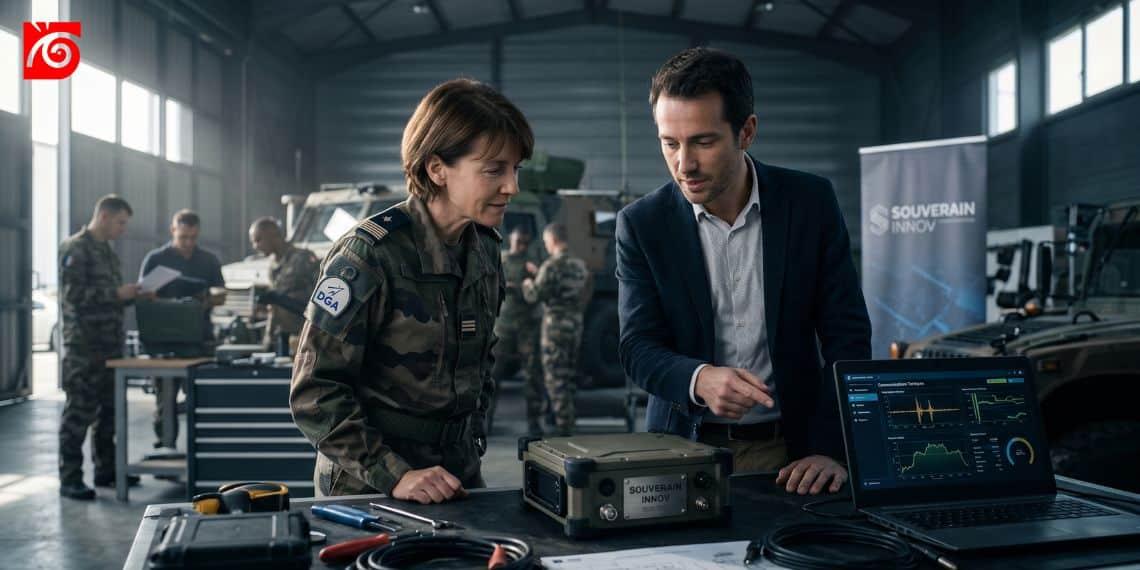
Your technology is remarkable. Your discretion is professional. But if the DGA officer looking for a solution for an emergency POC doesn’t know you, you don’t exist on his decision-making radar. And while he’s searching, he chooses someone else—not necessarily more competent, but infinitely more visible. The paradox of defense is that operational secrecy is a requirement, but brand invisibility is commercial suicide. This article explains how to solve this equation: protect what needs to be protected, and make visible what needs to be visible.
A 42-year-old engineer, the technical director of a small Breton company specializing in embedded cybersecurity, recounted the scene at a defense trade show: after seven years of working as a subcontractor for Naval Group, he happened to run into a DGA officer who asked him, “What exactly does your company do?” He answered. The officer’s eyes lit up: “That’s exactly what we need for a POC. You weren’t on our list.” Two months later, the contract was signed. Directly. Without an intermediary.
This anecdote illustrates a structural trend that is gaining momentum. Orders placed by the DGA have risen from 20 billion euros in 2023 to 38 billion in 2025—a level described as “unprecedented” by the Ministry of the Armed Forces, with projections reaching 42 billion for 2026 under the 2024–2030 Military Planning Law, totaling 413 billion over seven years. This explosion in spending creates a pressure to deliver results that industrial giants can no longer absorb on their own. The DGA is turning to SMEs. Directly. Quickly. But only to those it sees. (Read also: L’Essentiel de l’Éco).
There is a deeply held belief in the defense industry: to communicate is to take a risk. To reveal. To expose. So we stay silent. We develop. We deliver. We remain in the comfortable shadow of subcontracting.
There is a logic to this approach. It has made sense for decades, when large corporations filtered opportunities and distributed contracts among their loyal network of subcontractors. That model is now beginning to crumble.
The French high-tech industry consists of approximately 10 major groups and more than 4,000 SMEs, 350 of which are considered strategic, representing more than 200,000 highly skilled jobs that cannot be outsourced. Of these 4,000 SMEs, how many have a brand that is recognizable to a senior government official? A handful. The rest exist in Excel spreadsheets of subcontractors, not in the minds of public procurement officials.
Operational secrecy is a necessity. Brand invisibility is a choice—and a bad one at that.
The confusion between the two is at the heart of the problem. Protecting an algorithm, a frequency, or a composite material is a matter of operational secrecy—it’s legitimate, and it’s even mandatory. But keeping your mission, your strategic positioning, and your ability to deliver a POC in 90 days under wraps is commercial self-sabotage.
In a sector as strategic and sensitive as defense, where precision, confidentiality, and impact are essential, the ability to stand out in domestic and international markets is often crucial to the long-term survival of innovative SMEs. Communication in this sector does not contradict secrecy—it precisely defines its scope.
Understanding the DGA’s current procurement process means understanding why visibility has become a selection criterion as important as technical expertise.
The Defense Innovation Agency, which has operated under the authority of the General Delegate for Armaments since its creation in 2018, brings together all stakeholders—manufacturers, SMEs, startups, and research organizations—around eight technical innovation clusters located across the country. The 2024–2030 Military Planning Law allocates €10 billion to innovation, with a dedicated budget reaching €1.3 billion in 2025, exceeding the initial trajectory.
This budget is not allocated exclusively to Thales or Naval Group. The RAPID program, designed to be extremely responsive, aims to provide funding to selected projects within four months of the submission of the application and the start of work. Four months. That is how quickly the DGA can engage directly with an SME to validate a prototype. (See also: ISTRIUM CONSULTING)
The operational emergency process shortens the standard timeline from 11 to 5 months. These emergencies account for a growing share of procurement activity. And to handle them at this pace, the DGA officer cannot undertake a comprehensive technology watch. Instead, they rely on what they already know—what is stored in their brand memory. (See also: IE Portal)
The DGA has established a platform for direct meetings between SMEs and buyers. These events enable companies offering dual-use technologies to learn about markets and ministerial support programs, and to meet with various ministerial representatives—including the DGA, AID, and procurement departments—as well as major industrial firms during one-on-one meetings.
These events provide an opportunity for small and medium-sized enterprises (SMEs), mid-sized companies, and startups to strengthen their partnerships with key players in the defense sector. (Event calendar: Ministry of the Armed Forces)
But here’s what nobody tells you: these one-on-one meetings only last 20 minutes. The DGA official sitting across from you has met with 15 other SMEs that day. If you don’t arrive with a brand identity that’s already memorable, if your “Why” isn’t immediately clear, you’re just another SME. Competent, certainly. Memorable, no.
In the defense sector, we are seeing the emergence of asymmetric coopetition strategies, where the agility of SMEs complements the firepower of large corporations. However, a significant imbalance in terms of resources and market influence persists between SMEs and large corporations. (See also: University of Montpellier)
This imbalance isn’t just financial. It’s a matter of brand recognition. Thales has been investing in its brand for decades. You, perhaps not even a single day. The result: when the DGA is looking for a “critical component” for a system, Thales is the first name that comes to mind. Your technology is sometimes better. It’s just invisible.
The answer isn’t “communicate more.” It’s “communicate effectively, focusing on what sets you apart, and targeting decision-makers.”
This is what we call “surgical clarity ”: a branding strategy designed to be perfectly clear within a defined scope, to a defined audience, and centered on a specific message—without ever compromising operational security.
Simon Sinek didn’t write *Start With Why* just for Silicon Valley startups. He wrote it for every organization that needs to convince others before they’ve had a chance to assess the “what.”
In the defense sector, your technology is often your secret. But your mission of sovereignty can be articulated, expressed, and embodied without risk.
Compare these two phrases:
| What you often say | What you should say |
|---|---|
| “We develop electromagnetic detection systems.” | “We are ensuring that French sensors remain secure against enemy jamming threats.” |
| “Our solutions comply with NATO standards.” | “We are the solution that DGA teams choose when they don’t want to rely on a foreign supplier.” |
| “An innovative SME in embedded cybersecurity.” | “We protect the French military’s critical systems against attacks they haven’t yet anticipated.” |
The second column doesn’t reveal any technical secrets. It defines a mission. It builds brand equity. It answers the question that the DGA officer asks himself: “Can I trust this SME to be a critical component of my system?”
LinkedIn is the only platform where a DGA officer, an AID program manager, a procurement director at Naval Group, and a journalist from the magazine *Défense & Sécurité Internationale* can all appear on the same news feed without requiring any special clearance.
LinkedIn allows you to reach a qualified audience, boost your employer brand’s visibility, and streamline your hiring process. An SME can use it to build brand awareness, find partners, recruit more effectively, or even secure new contracts through targeted and professional communication.
For an SME in the defense sector, a LinkedIn strategy isn’t about volume. It’s about targeted visibility. Three to five posts per month, focusing on:
An industrial SME—far from being an industry giant—can capture the attention of LinkedIn by highlighting its teams, sharing everyday stories, featuring employee profiles, and showcasing moments of pride: all authentic content that can quickly boost brand awareness.
The difference is vast. Making a name for yourself in just 20 minutes during a one-on-one meeting is nearly impossible. But being recognized because the person you’re speaking with has already seen your profile on LinkedIn, read an article about your participation in a RAPID event, or heard about you from a peer—that’s doable.
Many hidden gems are identified through monitoring seminars, school publications, and SME materials. This sentence, taken from an analysis of innovation funding by special forces, says it all: identification comes before the trade show. The brand comes before the meeting. (Source: IE Portal)
Surgical transparency isn’t just a communication exercise designed to please a marketing director. It’s a direct business driver with measurable effects across three dimensions.
Direct access to POC contracts. Without going through a “third party,” without paying a commission to a large intermediary group, and without depending on the goodwill of a Naval Group program manager. It is essential to provide manufacturers with visibility so that the industry can make long-term investments. This principle works both ways: the DGA wants to engage with its SME partners, and the SMEs that do so secure the contracts that others miss out on.
Greater financial value. A defense SME with a recognizable brand, a clearly defined mission, and a well-documented presence is less easily replaceable. It is better positioned to negotiate terms. Sharing the added value among stakeholders helps retain critical expertise in France while pooling development costs. Being identified as a “critical component” radically changes your position in this value chain.
The ability to establish your brand as an integral part of a system. That is the holy grail. When your technology is integrated into a DGA program—not as an anonymous subcontractor, but as a named partner—your company becomes a benchmark. It attracts top talent. It reassures investors. It withstands attempts at substitution.
Two truths coexist in the French defense industry, and they are not contradictory.
First, certain information must never be made public. This is a legal, ethical, and strategic obligation.
Second: Your commitment to sovereignty, your ability to deliver, your industrial reliability, and your stance on national defense issues can and must be clear. For DGA officers managing a POC budget. For AID program managers seeking a critical component. For future engineers looking for a meaningful project.
The DGA publishes industry guidance notes on specific topics—surveillance drones, 3D printing, naval drones—to provide companies with a clearer understanding of these areas and guide them toward the DGA’s specific needs. The DGA is doing its part. It communicates its needs. It organizes its SME Tours. It makes its RAPID budgets available. It cannot do your branding work for you.
The window of opportunity is open. The budgets are in place. DGA officers are on the lookout. The question is no longer “Should we reach out?” It is: “Do you show up on their radar when they’re searching?”
Autour de l’Image helps SMEs and mid-sized companies in the BITD sector build a brand strategy that both protects their trade secrets and resonates with their target decision-makers.
That is precisely the purpose of the Influence & Authority Engine : a service designed for companies that have mastered their technology but have not yet translated their uniqueness into actionable brand equity—on LinkedIn, at defense trade shows, and in proposals for calls for proposals.




