
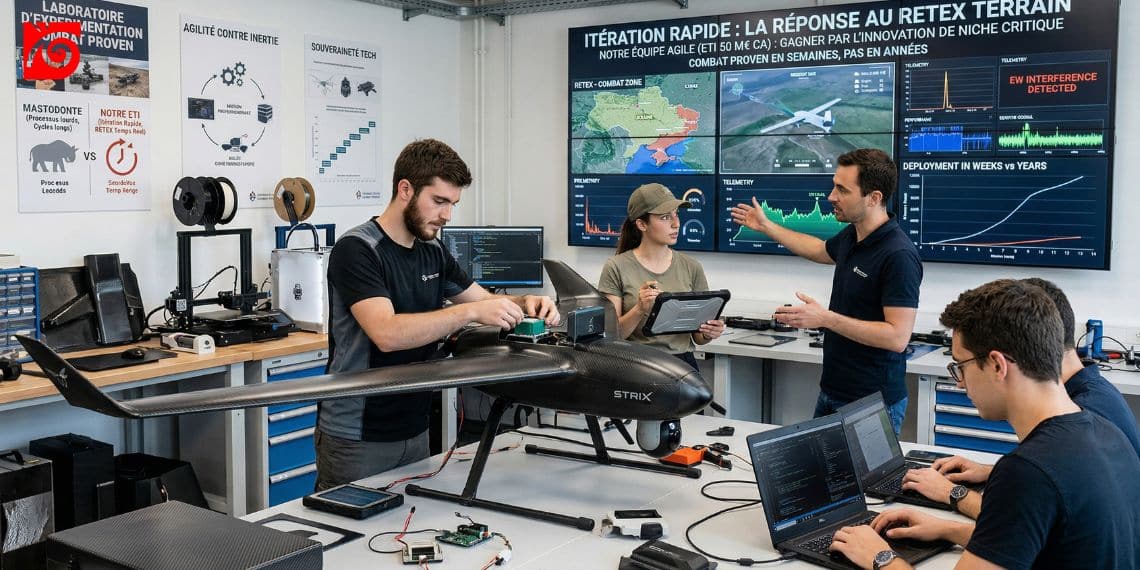
On the tarmacs at Le Bourget or in the aisles at Eurosatory, power is often measured by the square footage occupied by Thales, Dassault, or KNDS. Yet a quiet revolution is underway: one of agility versus inertia. For a mid-sized company with €50 million in revenue, direct competition is a death sentence. To succeed, companies must stop being “small but fat” and become “big specialists.” This article analyzes how French gems like Delair and Eos Technologie are shaking up the established order by replacing the “gold-plating” procedures of industry giants with real-world solutions. Discover how to sharpen your positioning so you’re no longer the risky choice, but the obvious one.
In the world of defense and high technology, the “David versus Goliath syndrome” isn’t just a metaphor—it’s a daily reality in business. When your prospect is a government agency or a major client, reassurance is the primary currency.
Thales and Naval Group don’t just sell systems; they sell the (sometimes illusory) certainty that the company will still be around in thirty years.
Yet the paradigm is shifting. Technological obsolescence has become so rapid that financial sustainability no longer guarantees operational superiority.
“Gold plating”is a chronic problem in major defense programs: the desire to design a perfect system that meets 100% of specifications set five years ago, at a sky-high cost.
The Opportunity for Mid-Sized Companies: Today’s world demands “Good Enough, Fast Enough.”
A company with €50 million in revenue doesn’t have the layers of bureaucracy that turn every technical change into a six-month approval process. Your strength lies in iteration.
The history of the Toulouse-based company Delair is much more than an industrial success story; it is a manifesto for all mid-sized companies that believe size is a hindrance. Initially a leader in civilian drones for infrastructure inspection (SNCF rail lines, quarries), Delair executed a strategic pivot toward defense that is now considered a textbook case within the Ministry of the Armed Forces.
Delair’s success does not stem from financial clout greater than that of a company like Thales, but from conceptual agility. When the need for reconnaissance drones became urgent in Ukraine, Delair did not seek to design a heavy and costly “combat platform.” Instead, they militarized their existing lineup (the DT26 and DT46), which had already been proven through thousands of hours of civilian flight.
The results speak for themselves: more than 150 drones delivered and operational in record time. While the traditional procurement cycles of the industry giants take years, Delair measured its timeline in weeks.
On the Ukrainian front, the enemy isn’t just missiles—it’s electronic warfare (EW). Russian forces are flooding the airwaves with signals that render drones “blind” and “deaf” by cutting off their GPS and command links.
The inertia of giants: To modify the data link system of a major program for a large client, it is often necessary to go through qualification committees, wind tunnel tests, and renegotiations of comprehensive maintenance contracts.
The Delair Method: By leveraging an open software architecture, Delair has been able to integrate “optical flow” algorithms and dynamic frequency hopping.
The reality on the ground: If a new Russian jamming frequency is detected on Monday, Delair engineers can test a fix by Wednesday and deploy it via a software update on the front lines by Friday. This ability to gather feedback in near real time is the ETI’s ultimate weapon.
Delair realized before anyone else that modern drones are smart consumables. In Ukraine, the average lifespan of a drone is sometimes only a few days.
Many mid-sized companies believe that to succeed, they must adopt the same corporate tone as their giant competitors. That’s marketing suicide.
Corporate Marketing (Them) : “We secure the nation’s future through comprehensive integrated systems.”
The Rebel's Marketing Pitch (You): “We neutralize FPV drone threats in urban areas with 98% accuracy.”
By trying to come across as a “generalist” or “systems integrator,” you’re simply highlighting your shortcomings (less capital, less lobbying power). By becoming a hyper-specialist, you become the indispensable partner that even a large corporation will need to round out its offerings.
Growing from €400,000 to €10 million in revenue in record time is no accident, but rather the result of a precise analysis of the weaknesses of major engine and aircraft manufacturers. While giants like Dassault and Thales exhaust themselves building flying “Swiss Army knives” capable of doing everything (but costing as much as a fighter jet), Eos Technologie has chosen an asymmetrical path: that of critical mass and attrition.
The traditional doctrine of defense is that of survivability at all costs. Drones are built with such advanced technology and at such a high cost that a general hesitates to send them into combat for fear of losing a significant portion of his annual budget with a single enemy shot.
The Eos Breakthrough : The Bordeaux-based company has realized that on a modern battlefield (as seen in Ukraine or Nagorno-Karabakh), drones are just another form of ammunition.
The “disposable” drone: Eos manufactures drones such as the Strix and the V Endurance. They are high-performance (capable of flying for 3 to 5 hours) but designed to be “lost” without causing a strategic or financial disaster.
Cost as a weapon: By reducing costs to one-tenth or one-twentieth of those of solutions offered by major corporations, Eos enables militaries to saturate the airspace. When facing an Eos drone, the enemy sometimes spends more on an interceptor missile than the drone itself costs. This is pure economic asymmetry.
Eos doesn't claim to be a jack-of-all-trades. They don't sell comprehensive combat systems, satellites, or long-range radars. They sell endurance. Their specialty? Carbon-fiber electric vertical takeoff and landing (VTOL) drones.
Control of the value chain: Unlike many startups that are merely “assemblers” (purchasing off-the-shelf components from China), Eos manufactures its own molds, carbon fiber frames, and motors.
Sovereign independence: This vertical integration reassures government buyers. In the event of a global crisis, Eos doesn’t have to wait for parts from Asia. They manufacture in Bordeaux. For a mid-sized company of this size, this is a major selling point compared to the giants with their globalized—and sometimes opaque—supply chains.
Eos’s strength lies in its ability to move from prototype to mass production in just a few months. Whereas a large corporation must adhere to project review milestones (PDR, CDR) that span years, Eos employs methods drawn from agile “Deep Tech”:
AI-assisted design for aerodynamic optimization.
3D printing and carbon infusion to test different cell designs in 48 hours.
The “Fail Fast” culture: If a wing can’t handle the load, we redesign it that same afternoon. At a large corporation, that would require three executive meetings and a budget impact analysis.
Eos cleverly identified what Thales and others no longer wanted to do: the light tactical drone segment, deemed too unprofitable compared to the colossal margins of major aerospace programs. By filling this strategic “gap,” Eos has made itself indispensable. Today, the major conglomerates themselves are beginning to view Eos not as an annoying nuisance, but as a strategic partner capable of providing them with the agility they have lost.
The conflict in Ukraine has served as a catalyst for revealing the truth. It has shown that long development cycles are ill-suited to modern electronic warfare.
| Dimension | The Mastodon (KNDS/Thales) | Agile ETI (Your Company) |
| Update cycle | 12 to 24 months | 2 to 4 weeks |
| Feedback loop | Steering Committees | WhatsApp with field staff |
| Unit cost | Very high (non-consumable) | Optimized (acceptable attrition) |
| Innovation | Top-down (R&D Department) | Bottom-up (Urgent operational need) |
For a public buyer, choosing a mid-sized company with €50 million in revenue is seen as a risk. You need to shift that perception.
Preligens (AI for geospatial intelligence) didn’t beat the giants by lowering its prices. It won by being the world leader in a specific segment: the automatic analysis of satellite imagery using AI. It invested heavily in its governance framework to ensure complete autonomy and expertise—something the industry giants tried to emulate through acquisitions or belated partnerships.
The asymmetric selling point:
“If you choose the big firm, you’ll be their 150th priority and get a team of junior consultants. If you choose us, you’ll have our top global experts, and your success is our number one priority.”
Preligens specializes in AI-powered Geospatial Intelligence (GEOINT).
In practical terms: the military and intelligence agencies receive terabytes of satellite imagery every day. A human cannot review it all. Preligens’ flagship software, called ROBIN, automatically analyzes these images to:
Detect and identify objects (aircraft, tanks, ships, missiles).
Spotting anomalies: “Hey, there are usually three submarines at this base, but today there aren’t any.”
Supporting decision-making in near real time.
In 2024, the Safran Group acquired Preligens for approximately €220 million. Today, in 2026, the company is part of the Safran Electronics & Defense division, while retaining a degree of autonomy to maintain its “agile” startup spirit.
Sovereignty: It allows France (and Europe) to avoid relying on American solutions (such as Palantir) to analyze its sensitive data.
Note: Their algorithms are capable of distinguishing one specific tank model from another, even in low-resolution images or in poor weather conditions.
Expansion: They are no longer working solely on imagery, but also on acoustic signals and open-source intelligence (OSINT).
France’s new Defense Authorization Act allocates 413 billion euros to defense, with a clear political commitment to supporting small and medium-sized enterprises (SMEs) and mid-sized companies throughthe Defense Innovation Agency (AID). Initiatives such as RAPID and ASTRID are no longer mere subsidy schemes, but gateways for testing breakthrough technologies.
To succeed, you must use these tools not as an end in themselves, but as a mark of credibility. A successful RAPID project is a seal of approval from the DGA (Directorate General of Armaments) that is worth more than all the financial statements in the world.
The question is no longer whether you can beat Thales, but where you’re going to beat him.
Winning a market against the giants requires ironclad discipline in positioning. You must be the expert in the “critical niche.”
The success of Delair, Eos, and Preligens is not due to luck, but to a perfectly executed “disruptive” strategy:
Faster iteration speed.
A deep connection with the end user.
Clarity of the technical message.
None of this is possible if your leadership is flying by the seat of its pants. To grow from €50 million to become an industry leader capable of taking on the giants, you need what we at Autour de l’Image call the Governance Foundation.
It is this asset that enables you to transform a brilliant technical idea into a solid business vision capable of winning the trust of banks, government agencies, and top talent. Without a clear governance framework, you remain a fragile “tech startup.” With it, you become a rising powerhouse.




