
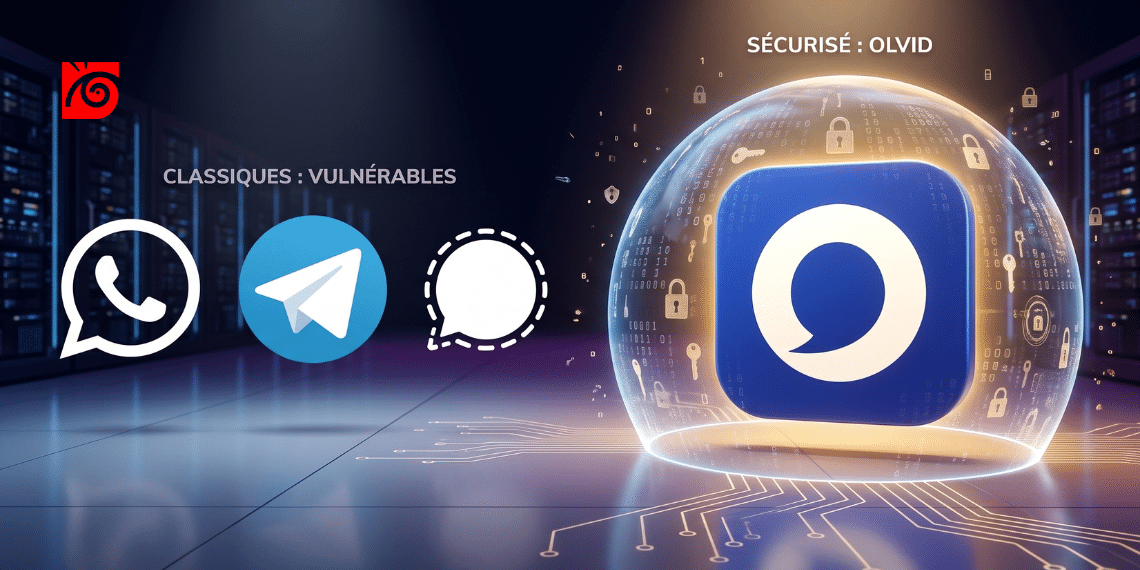
Instant messaging has become the nervous system of organizations. It’s used to exchange strategies, contracts, R&D data, and crisis decisions. Yet most of these conversations take place on platforms whose actual security is poorly understood. They all use the same buzzwords: “secure,” “private,” and “end-to-end encrypted.” Behind these words, the actual level of protection varies greatly, and the real question is rarely asked: Do you really know who you’re talking to? This article draws on the technical comparison published by Olvid, compares SMS, WhatsApp, Telegram, Signal, Matrix, Threema, SimpleX, and Olvid, and then explains why technical superiority alone does not win over the market without a clear positioning strategy.
In November 2023, a circular sparked a national controversy. Prime Minister Élisabeth Borne asked members of the government and ministerial staff to use Olvid (or Tchap) instead of WhatsApp, Signal, and Telegram.
Two reasons were cited: French sovereignty and security deemed to be superior. The president of the Signal Foundation, Meredith Whittaker, immediately responded that the “security flaws” cited against Signal were not supported by any evidence.
Three years later, Olvid responds with concrete evidence. The company has published a public comparison of messaging app security, criterion by criterion, that anyone can verify. The authors acknowledge their bias from the outset: they are the developers of one of the solutions being evaluated.
This comparison clears up a common misunderstanding. People often confuse three concepts: sovereignty (who controls the servers), encryption (is the content unreadable in transit), and actual security (who can intercept, impersonate someone, or exploit what remains visible). For a defense contractor, an executive, or a security manager, this confusion can be costly.
Why End-to-End Encryption Is Only Half the Equation
Almost all reputable email services now encrypt message content. This is necessary, but not sufficient, and Olvid’s benchmark explains why—with a distinction that few other comparisons make.
Encryption ensures that only those with the correct keys can read your messages. Authentication ensures that those keys actually belong to the person you’re writing to. Without it, the service provider—or anyone who hacks into it—can impersonate one of your contacts: the encryption still works, but it’s directed at the wrong person. The benchmark sums it up this way: “Perfect encryption to the wrong person protects nothing.” Olvid refers to the combination of these two safeguards as end-to-end security.
That leaves the issue of metadata exposure. Even when the content is unreadable, a server can see who is communicating with whom, when, and how often. For example: if we observe that a general counsel is suddenly engaging in intense communication in the middle of the night with a law firm specializing in mergers and acquisitions, there’s no need to read the messages to understand that a deal is in the works. The benchmark is straightforward on this point: any relay server can observe the “social graph” of its users, including Olvid’s. The difference lies in what the nodes of this graph contain: real identities (phone number, name) or simple pseudonyms. (Olvid, “Minimal Personal Data” criterion)
The true hierarchy of security therefore boils down to three questions: Are my messages unreadable? Am I certain of the identity of the person I’m communicating with? What can be learned about me without reading my messages?
Text messaging: the least secure form of messaging—and the cornerstone of the others
Let’s start at the bottom of the scale. SMS is still widely used, particularly for two-factor authentication, even though it relies on the SS7 protocol, which was designed in the 1970s. According to the Electronic Frontier Foundation, SS7 includes neither authentication nor encryption, and governments, cyber mercenaries, and criminals have exploited it to intercept and read text messages.
These attacks are happening in the real world. In 2024, a cybercriminal group intercepted text messages from thousands of bank customers in Europe and emptied accounts of several million euros in a matter of hours—without using malware: all they had to do was exploit vulnerabilities in SS7. These same vulnerabilities make it possible to track a phone’s location without the owner’s knowledge.
Olvid’s benchmark highlights a lesser-known—yet crucial—point. SMS isn’t just an insecure messaging protocol; it’s often the key to “secure” messaging apps. WhatsApp, Signal, and Telegram link an account to a phone number, and a new key can be registered simply by entering a code received via SMS. According to the benchmark, intercepting an SMS can thus be enough to take control of an account and impersonate its owner to all of its contacts. (Olvid, “No Identity Substitution” criterion)
Conclusion: When exchanging sensitive information, assume that any text message can be read by others. And whenever your messaging system relies on an SMS code, it inherits this vulnerability.
WhatsApp: Encryption for Billions of Users, but a Carrier That Relys on Data for Its Revenue
WhatsApp deserves real credit: by adopting Signal’s protocol in 2016, it brought end-to-end encryption to billions of people, with no option to disable it. Olvid’s benchmark acknowledges this. It also notes that WhatsApp demonstrates, better than any other app,that encrypted content alone does not make for private communication. (Olvid, WhatsApp profile)
First issue: authentication. To add a contact, simply enter their number: the app retrieves their key from Meta’s central directory and automatically relies on it. According to Olvid, the official claim that WhatsApp cannot see the content of messages is therefore inaccurate: the carrier, which distributes the keys itself, can technically intercept a conversation. Another point noted: the alert that notifies your contacts when your key changes is disabled by default, so a key substitution goes unnoticed.
Second issue: what encryption doesn’t cover. By default, backups are sent to iCloud or Google Drive without end-to-end encryption. The benchmark highlights that this vulnerability is contagious: all it takes is for one of your contacts to back up using the default settings to expose your conversations with them. Metadata, your address book, and interactions with Meta’s AI assistant are also not covered by end-to-end encryption.
Third issue: the code is closed-source. WhatsApp is the only app in this comparison whose application is not open source. Researchers had to reverse-engineer its multi-device functionality in order to analyze it.
Fourth problem: the attack surface. Anyone who knows your number can send you content without your consent. The most notable “zero-click” attack in 2019 occurred via WhatsApp: a single call—even if unanswered—installed the Pegasus spyware.
The legal situation has also become more tense. On May 21, 2026, the Texas attorney general filed a lawsuit against Meta and WhatsApp, accusing them of leading 3.3 billion users to believe that no one could read their messages. Meta strongly disputes the allegations.
Verdict: WhatsApp is suitable for the general public. Its business model (centralized address book, closed-source code, backups exposed by default, and a service provider that derives most of its revenue from advertising) makes it unsuitable for sensitive or sovereign communications.
Telegram: A Reputation for Security Based on a Misunderstanding
Telegram has some real strengths: fast apps, plenty of features, and open-source clients. But Olvid’s benchmark is clear: it’s the only messaging app in the comparison that doesn’t support end-to-end encryption. By default, conversations are stored on Telegram’s servers, which hold the encryption keys. End-to-end encrypted “secret chats” are optional, limited to one-on-one exchanges, and tied to a single device. Groups and channels are never end-to-end encrypted. (Olvid, Telegram profile)
The benchmark highlights an aggravating risk. On Signal or WhatsApp, an attacker who takes control of an account can only access future messages. On Telegram, however, the attacker also gains access to the entire message history, since it is stored on the servers and sent to any newly registered device.
The Durov case illustrates a broader lesson. After being placed under investigation in France in August 2024, the founder of Telegram saw his platform change its policy a month later: IP addresses and phone numbers are now disclosed upon a court order. The benchmark does not criticize Telegram for complying with the law. It draws a conclusion: privacy based on a provider’s promise crumbles the moment that provider changes its mind or no longer has a choice. A messaging service that is secure by design can hand over everything it holds to the courts without exposing conversations, because it has never held the content itself.
Verdict: Telegram is a good tool for sharing information, but it is not a secure messaging app.
Signal: The Gold Standard in Encryption, but an Operator Acting as a Trusted Third Party
Olvid’s benchmark readily acknowledges Signal’s significance: no other messaging app has done as much to make end-to-end encryption mainstream. Its protocol has been extensively studied by researchers, its code is open-source, and Signal is now ahead of the curve on post-quantum encryption: a hybrid key exchange since 2023 and a “triple ratchet” deployed since October 2025. (Olvid, Signal profile)
However, these initial design choices come at a cost. Signal began as a tool for encrypting text messages: it therefore identifies its users by their phone numbers and relies on a central directory. The benchmark explains that these choices make the operator a trusted third party, and sums it up with the phrase: “Every question the user is spared is a power granted to the server.” In practical terms:
- Authentication is based on the directory. Verification of “security numbers” (60 digits) is optional, cumbersome, and rarely performed. Furthermore, it must be repeated every time you change phones.
- The account can be recovered via text message. Additional security measures (PIN code, registration lock) are optional, and the benchmark specifies that after seven days of inactivity, the account can once again be recovered via text message alone. The 2022 Twilio incident demonstrated this: at least one Signal account was re-registered by an attacker.
- The device-adding feature was exploited. In early 2025, phishing campaigns documented by Google tricked users into linking an attacker’s device to their account using fake invitation QR codes. Signal has since strengthened the process.
The benchmark highlights a recent development: “Signal Login, ” which has been in beta on Android since September 2026, allows users to use Signal without a phone number. The feature is a paid option and protects against SMS interception, but not against spoofing by the central directory itself.
One detail will be of direct interest to the BITD: the benchmark cites a memo from the Ministry of the Armed Forces’ CERT for defense companies regarding the security of Signal on Android. This suggests that Signal is in use within the defense ecosystem, and the memo shows that it requires significant configuration work.
Verdict: Signal is excellent for ordinary citizens. But its security depends on trusting the operator, and it is a U.S.-based organization; therefore, it does not meet the need for sovereign control over the entire chain.
Tchap, Citadel, Element: Sovereignty Through Hosting Is Not Enough
This point is essential for national defense, as it concerns the sovereign alternatives themselves. Tchap, the French government’s messaging service, and Citadel, the solution from Thales, are based on Matrix, an open and federated protocol: each organization can manage its own server. The Olvid benchmark acknowledges that this model supports sovereignty. (Olvid, “Based on Matrix” fact sheet)
His concern relates to the design. Matrix was originally designed for chat rooms replicated across servers, and end-to-end encryption was added later as an optional module. The user’s identity is their account, which is hosted by their server. Data from a chat room is replicated on the servers of all participants. The benchmark concludes that, in a federated system of this type, actual security tends to be limited by the weakest link: it only takes a single member registered on a poorly managed server for the chat history and metadata to be permanently stored there.
The benchmark adds a useful point of clarity to the debate on hosting: if security is truly end-to-end, the server operator and the servers’ location no longer matter. It is precisely because Matrix does not achieve this level that we must trust the server operators.
For a defense contractor, the message is clear: simply hosting a solution in France is not enough to make it secure. This is all the more strategic given that Thales, through Citadel, is both a client and a direct competitor in this niche. We detail how to position oneself against a major corporation in our analysis of how a mid-sized defense company can succeed against Thales.
Threema and SimpleX: Serious Alternatives to Accepted Compromises
The benchmark includes two lesser-known email services that, like Olvid, do not collect personal data.
- Threema (Switzerland) operates without a phone number or email address, using an eight-character identifier, and the associated key can never be replaced. However, establishing connections remotely relies on its central directory. The benchmark also notes that anonymity is collective: a user who wishes to remain anonymous can still be identified if their contacts have linked their real-world identity to their account. (Olvid, Threema profile)
- SimpleX goes the farthest in minimizing data: no global identifier, not even a permanent key. The trade-off: without a stable identity, no contact can vouch for another, and a remote connection is secure only if the channel transmitting the invitation is secure. The benchmark summarizes this choice as follows: SimpleX prioritized maximum anonymity over usable authentication. (Olvid, SimpleX profile)
Olvid: An architecture in which the server plays no role in security
Olvid’s founding principle is summed up in a single sentence from its benchmark: “No server should play a role in the security of transactions.” Everything else follows from this. (Olvid, Olvid fact sheet)
Identity is the key. On Olvid, a user is neither a phone number nor an entry in a directory, but a pair of cryptographic keys. By default, there is no central directory linking an identifier to a key—and therefore nothing for an operator to hijack. The servers simply relay encrypted messages between people who have authenticated each other. According to Olvid, even if its servers were completely compromised, it would still be impossible to intercept any conversations.
Four ways to establish trust,all without the operator. No contact can be added without first verifying the link between the person and their key:
- face-to-face, by scanning a QR code twice;
- remotely, through the exchange of two four-digit codes (Vaudenay’s SAS protocol). According to Olvid, these eight digits reduce the probability of a successful attack to about one in 100 million per attempt;
- through a mutual contact, who introduces two people to each other whom he has already verified;
- by joining a group whose members are connected with one another.
These actions mirror those in the physical world: exchanging a business card, introducing someone. The benchmark derives a concept from this that could serve as the foundation for the entire brand platform: directory-based solutions ask you to trust something (a server, an infrastructure), whereas Olvid asks you to trust someone.
Identity substitution is not possible. Since the identity is the key, no phone number or email address can be used to link an account to a new key. Even with the optional company directory, a new key never replaces the old one in your contacts’ lists—it appears as a new contact.
No personal data is requested— no name, email address, phone number, or access to your address book. On Android, there’s even a setting that lets you disable Google notifications. For businesses, the benchmark highlights that this lack of data collection correspondingly reduces the amount of data processing that must be documented under the GDPR.
No messages from strangers. A user does not receive anything from a third party until they have accepted the connection. The only thing a stranger can send them is a request containing a name displayed in plain text. This significantly reduces spam, phishing, and the risk of “0-click” attacks such as Pegasus.
Validations by independent third parties. The trust-building protocol was subjected to a security proof by Michel Abdalla (CNRS, ENS). The cryptographic core was formally analyzed in a paper published at the ACM CCS 2026 conference. The apps received CSPN certification from ANSSI in 2020 for iOS and in 2021 for Android—a distinction no other messaging app had achieved. The code for the apps and the server is released under the AGPLv3 license.
A clear business model. Olvid generates revenue from its paid services to businesses and government agencies, not from data mining.
The limits that Olvid publishes himself
A sales document would likely gloss over these points. Olvid’s benchmark highlights them, and that’s what makes it credible:
- Post-quantum encryption: not available. Olvid’s channels currently rely on classical cryptography. A hybrid mechanism based on ML-KEM is planned for 2027. In this regard, Signal is ahead of the curve.
- Reproducible builds: not yet available everywhere. As of September 2026, they allow users to verify that the Android app distributed on F-Droid matches the published code, but not yet the one from the Play Store.
- The user carries their identity. Without secure backup enabled, the loss of a device results in the permanent loss of that identity: there is no service provider to ask to reset it, since no service provider has authority over the accounts. The benchmark presents this choice as a trade-off: stronger security in exchange for a higher level of user responsibility.
The AWS Debate, Seen from This Perspective
The main criticism leveled at Olvid concerned its hosting on Amazon Web Services—and thus its exposure to the U.S. Cloud Act. Thomas Baignères responded that the data was end-to-end encrypted and that the hosting had no impact on security. The benchmark provides the logical basis for this response: when the server plays no role in security, its location no longer matters. This is the central thesis of this article: proven security matters more than where the servers are located. The government’s GouvTech catalog also indicates that the service is hosted on a SecNumCloud-certified cloud.
Olvid's Comparison Matrix: Nine Criteria, Seven Email Services
Here is the summary published by Olvid. We are reproducing it without altering the results.
Criterion Olvid Signal Telegram Based on Matrix* SimpleX Threema End-to-end encryption ✅ Good ✅ Good ✅ Good ❌ Wrong 🟠 Midterm ✅ Good ✅ Good End-to-end authentication ✅ Good ❌ Wrong ❌ Wrong ❌ Wrong ❌ Wrong ❌ Wrong ❌ Wrong End-to-End Security ✅ Good ❌ Wrong ❌ Wrong ❌ Wrong ❌ Wrong ❌ Wrong ❌ Wrong No identity substitution ✅ Good ❌ Wrong ❌ Wrong ❌ Wrong ❌ Wrong ✅ Good ✅ Good Open-source client ✅ Good ✅ Good ❌ Wrong ✅ Good ✅ Good ✅ Good ✅ Good End-to-End Multi-Device ✅ Good ✅ Good ✅ Good ❌ Wrong ❌ Wrong ➖ Not applicable ✅ Good Minimum Personal Information ✅ Good ❌ Wrong ❌ Wrong ❌ Wrong ❌ Wrong ✅ Good 🟠 Midterm No user discovery or spam ✅ Good 🟠 Midterm ❌ Wrong ❌ Wrong ❌ Wrong ✅ Good 🟠 Midterm Post-quantum encryption ❌ Poor (projected for 2027) ✅ Good ❌ Wrong ❌ Wrong ❌ Wrong 🟠 Midterm ❌ Wrong
Legend: ✅ Correct · 🟠 Partially correct · ❌ Incorrect · ➖ Not applicable
* Element, Tchap, Citadel…Source: Olvid, Email Security Comparison, 2026. © Olvid, content licensed under CC BY-ND 4.0, results reproduced without modification. Each rating is explained in a detailed fact sheet for each application.
How to Read This Matrix
The decisive factor is the second point. Six out of seven messaging services encrypt properly, but only one provides end-to-end authentication. This is what makes the difference between “my messages are unreadable” and “I’m certain of my correspondent’s identity.” It’s also Olvid’s strongest argument—even more so than sovereignty.
Do the math. According to this rating system, Olvid scores eight “Good” ratings out of nine. SimpleX scores five, Signal and Threema four, WhatsApp two, and Telegram and Matrix solutions one.
The suspicion of bias is addressed head-on. Olvid acknowledges that a careful reader will see that its solution checks almost all the boxes. Its response: “We first defined the fundamental security criteria, then designed Olvid to meet them.” Each criterion is discussed separately, sources are archived, a dedicated page explains the criteria that were excluded (features, business model, malware protection), and there’s a link to report errors. Finally, Olvid’s red checkmark for post-quantum security speaks louder than any long speech.
Strategic Analysis: What the Matrix Does Not Measure—Intentionally
Olvid’s benchmark is limited to technical criteria and deliberately excludes business models, sovereignty, and certification. It also excludes messaging services without end-to-end encryption—such as SMS—as well as Teams, Google Chat, Slack, and Discord, where the service provider has access to all exchanged data. However, a buyer in the defense sector or a regulated industry also considers these criteria.
No single criterion is enough: SMS is independent of the GAFA companies and remains the least secure option. It is the combination of all these criteria that sets Olvid apart.
A lesson for businesses: In a medium-sized industrial company, Olvid’s real competitor is often neither Signal nor WhatsApp, but the collaborative suite that’s already in place. Explaining that a Teams message can be read by the operator—as Olvid itself points out—is undoubtedly the most useful selling point in a business setting.
Trust Capital: An Asset That Remains Undervalued
Olvid has built up a level of trust that most publishers take years to establish, but it remains largely hidden. Use cases and customer testimonials do exist, but they’re tucked away in the website’s footer: you have to expand menus to access this social proof. However, in B2B, buyers form a large part of their opinion before the first sales contact, as we explain in our analysis of the autonomy of B2B buyers in their purchasing journey. Any proof they can’t find during this phase doesn’t count.
Yet there is plenty of evidence:
- A government-level endorsement. RAID, an elite unit of the National Police, chose Olvid for its internal communications in 2021. Ministries, the Office of the President, and the DRSD use it.
- Independent scientific validation. Proof of security by Michel Abdalla (CNRS, ENS), formal analysis published in ACM CCS 2026, CSPN audits conducted by Synacktiv. The argument “the publisher says so” no longer holds water.
- An adoption outside the state. In 2026, the Val-d’Oise Bar Association adopted Olvid for communications among attorneys, and Soitec expressed its confidence in the Hexatrust white paper published in April 2026. A bar association and a semiconductor manufacturer: exactly the types of organizations that the public sector was unable to reach.
- A key use case: crisis management. The first use case identified by Olvid is maintaining business continuity when the information system goes down, for example, following a cyberattack.
- The benchmark itself. It may be the strongest asset of trust, because it acknowledges the strengths of competitors, highlights Olvid’s weaknesses, and encourages people to verify the information.
However, this benchmark was written by cryptographers for a technical audience. It will convince a CISO. A CEO, a security director, or a defense procurement officer needs someone to explain what concrete benefits they stand to gain: reduced risk of identity theft in export negotiations, business continuity in the event of a crisis, and simplified GDPR compliance.
The challenge is no longer to produce evidence, but to make it visible. A security director at the BITD isn’t convinced by an SAS protocol. He is convinced when he sees that an elite unit, a bar association, and a sovereign industrial firm have already made this choice, and that a public, verifiable comparison—one that is honest about its own limitations—explains why.
The Context That Changes Everything: Chat Control and the Vulnerability of Encryption
The European debate over the CSAR regulation, known as “Chat Control,” lends this comparison strategic significance. According to La Quadrature du Net and EDRi, the regulation could require encrypted messaging services—including WhatsApp and Signal—to analyze content before it is sent. Experts believe that such analysis cannot be carried out without compromising the integrity of the encryption.
In this uncertain regulatory environment, Telegram’s reasoning also applies to lawmakers: privacy that depends on the goodwill of the service provider or the government is only as good as that goodwill lasts. An architecture in which the provider cannot read or alter anything constitutes a strategic guarantee, not merely a technical refinement by cryptographers.
The Governance Framework: Why Olvid Shouldn't Target "Everyone"
With WhatsApp’s billions of users, the temptation to focus on volume is strong, and the slogan “messaging for everyone” is appealing. That is precisely the trap to avoid, as the story of Olvid shows.
When the Borne circular mandated the use of Olvid without any support, its adoption in institutions remained limited, according to the School of Economic Warfare. Users’ criticisms focused on the very features that make the tool strong: no contact list, the requirement to exchange codes before being able to chat, and no IT department to support a community of decision-makers. The benchmark confirms that this was a conscious choice: every convenience offered to the user by other platforms amounts to giving power to the server. Olvid made the opposite choice.
It’s impossible to be both the most security-stringent messaging service and the easiest to deploy for anyone. Trying to have both undermines the promise.
The Right Position: For Those Who Have Something to Protect
Olvid’s brand strategy must therefore take a clear stance. Olvid is not for everyone. It is the messaging service for those who value their integrity and believe their communications deserve a high level of security—whether they are a president or a minister, a business leader or a parent.
The benchmark even provides the accompanying narrative. Olvid doesn’t ask you to trust a server, but rather a person: the one you meet or the one who introduces you to them. The requirement then becomes a familiar reference point: you don’t add an Olvid contact the way you subscribe to a newsletter; you add them the way you exchange business cards.
"Email for Everyone" Approach A rationale "for those who protect their integrity" A head-to-head competition with WhatsApp—a lost cause from the start Creating a category where Olvid is the only option for authentication Constraints are a deal-breaker Challenges are a sign of commitment Vague target, generic message Target Audience: Government, BITD, executives, professions subject to confidentiality requirements The Battle Over Volume and Price A Battle of Courage and Confidence We put our trust in something We trust someone
This positioning also addresses a common risk faced by players in this sector: diluting the message by trying to speak to everyone at once. We discuss this risk in detail in our analysis of the blurred line between the civilian and defense sectors. Here, unity does not stem from the target market, but from a shared principle: the importance placed on the integrity of trade.
The Challenges of Scaling Up
Olvid has won the battle for legitimacy. Now it must win the battle for scale. By the end of 2023, the app had about 100,000 registered users—a significant number for a deep-tech company, but modest compared to the market leaders.
First challenge: replicating the “certification-then-mandate” model outside the government. As Stratégies noted, the example of Olvid shows that a regulatory requirement can accelerate adoption. Natural channels already exist: CERTs for defense companies, professional associations, NIS2 standards, and clusters such as EDEN.
Second challenge: turning the post-quantum roadmap into a narrative. The red box marked 2027 could become a public event. For a defense contractor, the “record now, decrypt later” risk speaks directly to them: program data captured today could be read in ten years. The benchmark clearly describes this risk, and we need to seize on it before others do.
Third challenge: translating technical evidence into value for decision-makers. The benchmark answers the question, “Is it safe?” The executive committee asks, “What do I risk by not adopting it, and what do I gain by doing so?” This shift from technology to strategic value is the classic challenge facing deep-tech companies, which we analyze in our article on the “techno-push” versus strategic value.
Fourth challenge: expanding beyond the public sector. Olvid’s capital of trust is drawn almost exclusively from the government. Yet defense contractors—from large corporations to mid-sized companies—and the entire private security sector (close protection, economic intelligence, security for sensitive sites) have needs that are just as critical. These actors do not identify with a discourse of “citizen sovereignty.” The link between defense and private security—which we describe in our analysis of the technological continuum between defense and private security—is the natural arena for this expansion.
Conclusion: Proven security as the foundation, positioning as the catalyst
According to the benchmark published by Olvid, the technical hierarchy is clear. SMS should be avoided and often serves as a gateway to other messaging apps. Telegram is not encrypted by default. WhatsApp does encrypt messages well, but it relies on a Meta directory and closed-source code. Signal is remarkable and ahead of the curve on post-quantum security, but it still relies on a trusted third party. Solutions such as Matrix, Tchap, and Citadel all depend on their servers. Olvid is the only one to combine end-to-end encryption and authentication, and it openly discloses its own limitations.
However, technical superiority alone is not enough to scale up. The Olvid initiative is based on three key drivers:
- A Bold Brand Governance Strategy (Governance Framework): Moving away from the mass market to become “the messaging service for those who protect their integrity.”
- Visible Trust (Capital Confiance): Move the social proof out of the footer and turn benchmarking into a selling point tailored for decision-makers.
- A Targeted Message (Influence & Authority Engine): Transforming the authority established with the government into authority with the BITD and the private security sector.
The Strategic Gateway
These three levers are part of the same approach. Before producing content or reorganizing social proof, we must determine the initial positioning: whom Olvid chooses to serve, and whom it chooses not to target. This is the purpose of the “Autour de l’Image” Governance Framework: to define the vision, the target audience, and the promise that will then give coherence to the messaging and the social proof.
Olvid already has the most advanced authentication technology—and even a public benchmark to prove it. What it lacks isn’t a feature, but a clear strategic decision regarding its brand identity. That’s where we come in.




